Monday, November 19, 2007

Mexico-Guatemala: The Other Border

Image
Mexico-Guatemala
The immigration experience of Central Americans offers cautions about current approaches to immigration reform, just as a U.S. debate on immigration fails to produce meaningful changes in immigration policies.

When the topic of immigration comes up in the U.S., the debate usually centers on the Mexico-U.S. border and the Mexican immigrants that make up a large portion of those who cross the border running along the states of California, Arizona, and Texas. Far fewer think about the significant number of immigrants who must cross multiple borders before they arrive in the U.S.

Pushed by the hope of finding new economic opportunities, thousands of Central Americans and others cross the border between Mexico and Guatemala. It is the natural gateway for the rest of Latin Americans. According to Mexico’s National Institute of Migration, 2 million documented and undocumented cross Mexico’s southern border a year.[1] The majority of these undocumented immigrants are Guatemaltecos, followed by Hondurans, Salvadorians, and a fewer number of Nicaraguans. They are either in route to the U.S or seeking temporary work in Mexico’s southern state of Chiapas.

Over the last years, difficult economic circumstances, lack of opportunities, along with natural disasters have increased undocumented migration. Since 2001, the number of undocumented Central Americans coming into Mexico has more than doubled.[2] This number is a low estimate considering it is hard to accurately document the actual number of undocumented immigrants who cross the border.

Central American immigration to Mexico, however, is no new phenomenon. During the civil wars of the 1980s, Mexico saw an increase of immigration from Central America as refugees fled genocide in their home countries. Natural disasters such as hurricanes Mitch and Stan have also put more pressure on already poor communities to migrate north. In the last two decades, however, a growing factor in Central American migration to Mexico has been the adoption of free-trade policies in the region.

Free-trade a Factor in Immigration

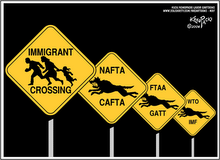
Free-trade policies, while trumpeted as the solution to Latin America’s underdevelopment and economic problems, have led to a loss of jobs, a decline in salaries, worsening working conditions and increased cost of living, all of which have exacerbated existing inequalities. NAFTA (North American Free Trade Agreement), the free trade agreement signed between the U.S., Canada, and Mexico, has been the most glaring example of the disastrous effects of these policies. Since its inception in 1994, Mexico’s small farmers have been forced into poverty as they lost land due to land privatization or went out of business due to their inability to compete with U.S. agricultural imports, especially corn. In turn, the general Mexican population has suffered a hard blow in the resulting rise in corn tortilla prices, one of Mexico’s principle food staples. Mexicans have also experienced increased unemployment, and a decline in quality and access to public services as a result of privatization. Another effect of reduced quality of life: immigration from Mexico to the U.S. increased by more than 61% in the first 8 years of the policy’s implementation.[3]


Central America is experiencing trends in the same directions with the initiation of its own free-trade agreement with the U.S., known as CAFTA (Central American Free Trade Agreement). CAFTA took affect last year after Guatemala, Honduras, El Salvador, Nicaragua, and the Dominican Republic signed agreements with the U.S. Much like its predecessor, CAFTA threatens to displace a large number of agricultural workers, forcing many into larger cities to search for other employment. This is worrisome, as the agricultural industry provides an important source of revenue, and Central American countries do not seem to have a viable economic replacement for a loss of jobs in this sector. Some of the negative affects of CAFTA can already be seen in the first year of its inception. In El Salvador, the first to implement CAFTA, exports to the U.S. have already dropped by more than half from $187 million to $88 million.[4] In Guatemala there has been an inundation of North American chicken in the domestic market, that has increased its price, despite promises that the free-trade agreement would reduce food costs.[5] In Honduras, while exports to the U.S. have increased by 1%, U.S. exports to Honduras have risen by 13%.[6]

According to some analysts, CAFTA’s promise of foreign investments is also an empty one. Umberto Mazzei, Director of the Institute of International Economic Relations in Geneva stated in a recent article that “The purchase of national companies by foreigners in particular - represents a transfer of property and not a new investment,” pointing to the fact that much of the profits end up leaving the country rather than being used to invest further in the nation.[7]

The loss of jobs in the agricultural industries, along with increases in the cost of living with fewer employment opportunities are speculated to produce economic and social hardships that will result in migration both within and outside Central American nations. Most of this migration will be directed towards Mexico and the U.S.

Image
Guatemalans Crossing into Mexico (Photo Credit: NY Times)
Women will be affected disproportionately as immigration patterns have changed over the years. According to the United Nations 2006 Migration and Development Report, women migrants represent one half of all migrants and are a larger group than men in developed countries. These women are being pulled by a demand to fill jobs in the domestic and service sector. Central American women have not escaped this trend, migrating north to work as housekeepers, nannies, hotel workers, caretakers of the elderly, as well as, a growing number of young Central American women entering the sex industry. Female immigrants also face the added risks of rape, physical abuse, and exploitation in their attempts to migrate across borders.

Business Boom in Traffic of Undocumented

Pushed by market forces to migrate north, immigrants are also becoming an increasingly profitable commodity themselves. Mexican immigration authorities have recognized that the traffic of undocumented immigrants is, after narcotrafficking, the second most profitable illicit business in the country and generates $10 billion dollars annually. The cost of a coyote, the name given to border smugglers, can easily reach thousands of dollars, an enormous price for those who are already trying to escape conditions of poverty.

Furthermore, paying a coyote does not secure an immigrant’s safe arrival on the other side of the border. Recently the New York Times reported a case in which a truck with 81 immigrants was abandoned in Monterrey, Mexico, leaving those inside trapped and sweltering. The Mexico-Guatemala border is no exception to these dangers, as undocumented immigrants from Central America face an increasingly militarized Mexican border.[8]

Mexico Looks to U.S. Militarization as Example

According to the conclusions of the 2001 International Colloquium on Security of Mexico’s Borders, “In Mexico, there is a tendency to push the U.S. border further south in terms of security and migration.”[9] That is, Mexico has adopted similar border policies to the U.S., which has meant an increased emphasis on combating narcotrafficking, terrorism, and securing borders.

Current president Felipe Calderón has focused much of his first year in office on cracking down on drug trafficking and organized crime. This has translated into an effort to militarize many parts of Mexico, and in particular the border it shares with Guatemala. Like the U.S., adjustments in Mexican immigration policies continue to stress military might over policy reforms as solutions to illegal immigration.

During a national forum on Mexico’s immigration policies in May 2005, Erubiel Tirado, the Coordinator for the Iberoamericana University’s National Security Program, referenced the relationship between Mexico’s immigration policies with those of the U.S., stating, “Our immigration policy in the region is expressed in a punitive form rather than one based on economic and social rationality…in which the anti-terrorist paranoia of the United States tightens its punitive controls at the federal and state levels of our country.”[10]

Militarization’s Threat to Human Rights

The boost in military units, bases, and patrols has had negative effects on Mexico’s civil population and on undocumented immigrants trying to enter Mexico’s southern state of Chiapas. In light of the new focus on fighting the drug trade, organized crime, and terrorism, undocumented immigrants face the increased danger of being tagged as narcotraffickers, gang members, or terrorists. Indigenous peoples of the region stand to face the brunt of this military profiling as one of Mexico’s and Central America’s most marginalized and discriminated populations.

The numerous deaths of innocent Mexican citizens at the hands of military soldiers this year alone has led the National Commission on Human Rights (CNDH) to call for the military to be “taken off the streets and [to] focus on their exclusive constitutional function of defending national security, not the persecution of delinquency.”[11]

These human rights violations by the Mexican military, along with the broken promises of economic growth in Mexico and Central America, is a telling story and one that can shed light on the U.S. stalemate on immigration. The future effects of CAFTA and increased militarization will prove unfortunate evidence of how strategies have failed to reduce undocumented immigration and secure the U.S.’s national borders.


Perhaps then policy makers and politicians will realize that investing in socially and economically just policies in the U.S. and in Latin America will be more successful at creating border security than military might and unbalanced trade agreements.

Vanessa Burgos is an independent journalist and human rights worker who has spent the last year covering human rights and immigration issues in Latin America.

http://upsidedownworld.org/main/content/view/1004/79/

Notes:

[1] Statistics from the Mexico’s Nacional Institute of Migration. www.inami.gob.mx.
[2] Ibid.
[3] Statistic as reported by Global Exchange.
www.globalexchange.org
[4] Amounts taken from a report from the Stop CAFTA Coalition, “Monitoring Report: DR-CAFTA in One Year”, September 12, 2006. www.stopcafta.org.
[5] Umberto Mazzei, “Guatemala: Two Months of CAFTA”, November 2, 2006. Posted on americas.irc-online.org.
[6] Percentages taken from a report from the Stop CAFTA Coalition, “Monitoring Report: DR-CAFTA in One Year”, September 12, 2006.
www.stopcafta.org.
[7] Umberto Mazzei, “Guatemala and Costa Rica: In and Out of CAFTA”, July 18, 2007. Posted on americas.irc-online.org.
[8] Betancourt, Antonio. "Mexico: 81 Migrants Found Trapped In Truck." New York Times (July 13, 2007).
[9]Conclusion of the forum “Seguridad y Migración Coloquio Internacional sobre la Seguridad en las Fronteras de Mexico”, posted on the website of Mexico’s Nacional Institute of Migration,
www.inami.gob.mx.
[10] Statement by the Coordinator for the Iberoamericana University’s National Security Program, Eurubiel Tirado in “Frontera Sur y Seguridad Nacional: El Olvido Intermitente”, part of the forum “Hacia una Politica Migratoria Integral en la Frontera Sur de Mexico”, Primero Foro (May 2005).
[11] National Comission on Human Rights (CNDH) taken from a report put out by Servicio Internacional Para la Paz,
http://www.sipaz.org/informes/vol12no2/vol12no2s.htm

Stéphane Dion interpellé

Manifestants

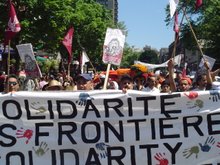
Des organisations de défense des droits de la personne ont manifesté samedi après-midi à Saint-Laurent, dans le nord-ouest de Montréal, où se trouve la circonscription du chef du Parti libéral du Canada, Stéphane Dion.

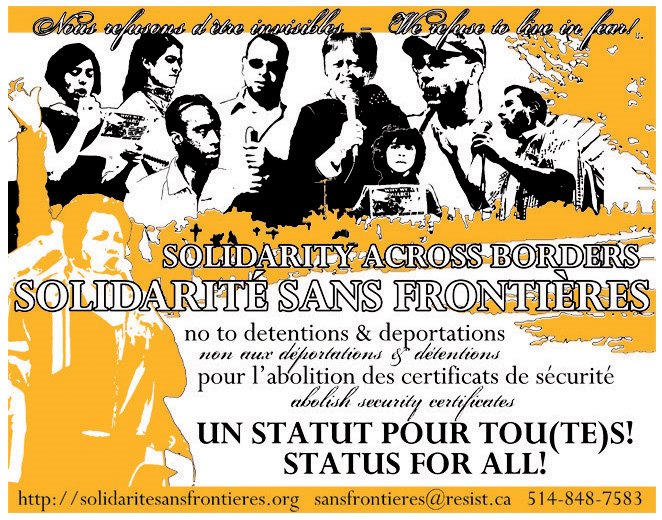
Les manifestants ont demandé au chef libéral de s'opposer au projet de loi C-3 sur les certificats de sécurité. En vertu de ceux-ci, le gouvernement peut détenir et de juger des immigrants qui ne sont pas citoyens canadiens sans que ces derniers aient accès à la preuve détenue contre eux.

À la suite d'une décision de la Cour suprême, le gouvernement Harper s'apprête à modifier la loi et à permettre ainsi à des avocats spéciaux de voir cette preuve. Toutefois, les personnes qui sont l'objet d'un certificat de sécurité n'auront toujours pas accès à cette preuve.

Adil Charkaoui, lui-même visé par un certificat de sécurité et actuellement en liberté surveillée, était présent à la manifestation. Il a lancé un appel à Stéphane Dion: « On lui demande de se joindre au Bloc québécois et au NPD, de voter contre cette loi injuste. On lui demande tout simplement de jouer son rôle de chef de l'opposition officielle. »

Au total, quelque 200 personnes ont participé à la manifestation, parmi lesquelles on retrouvait des militants d'extrême gauche, de musulmans et de militants des droits de la personne.

Le PLC avait indiqué, lors du dépôt du projet de loi C-3, qu'il n'avait pas l'intention de s'y opposer.

http://www.radio-canada.ca/regions/Montreal/2007/11/17/003-manif-certificats_n.shtml

Photo-reportage: http://photos.cmaq.net/v/nobillc3/

Protesters denounce Bill C-3 legislation

A group of more than 100 protesters took to the streets of Liberal leader Stéphane Dion's riding in St. Laurent yesterday - complete with marching band - asking him to oppose Bill C-3, the recently introduced security-certificate legislation. The proposed legislation "responds to none of the core concerns" raised in a public campaign, said organizers with the Coalition Justice Adil Charkaoui. The marchers delivered an open letter to Dion, signed by 45 groups, laying out a broad array of criticisms of the approach adopted by the minority Conservative government.

http://www.canada.com/montrealgazette/news/story.html?id=19cf6600-9d8a-4f72-a0fc-297fefb26207

To view photo essay: http://photos.cmaq.net/v/nobillc3/

Friday, November 16, 2007

HOUR: The debate is a farce


http://www.hour.ca/news/news.aspx?iIDArticle=13437

Muslim community leaders decry fallout from increasingly divisive reasonable accommodation dialogue

Islamic identity in Quebec rests at the centre of the current storm of debate surrounding reasonable accommodation as the rights of Muslim minorities in the province to publicly practise religious customs are under attack in a state-sponsored commission.

Startling many Canadians is the overt racism towards non-dominant cultures in Quebec, expressed repeatedly in hearings initiated by the Liberal minority government of Jean Charest on the eve of the last provincial elections. Québécois from the rural regions of the province are delivering a social discourse that is shaking the contested conception of Canada as a multiculturally tolerant society.

"The only way to return peace and harmony in Quebec is to ban religious accommodation," announced a woman participating in the state commission in Gatineau in October. Dominant symbols of Christianity in the province aren't up for discussion in the hearings, as the giant cross on Mount Royal continues to shine nightly in the sky.

Muslim community groups throughout the city are organizing their response to the current debate surrounding reasonable accommodation in the lead-up to the public hearings in Montreal, scheduled for Nov. 27 in French and Nov. 29 in English.

The civil rights of Muslim women within Islamic practices are being fiercely discussed throughout Quebec, often by non-Muslims in the rural regions of the province who have never encountered a Muslim face-to-face.

"I think that the motivation was not really to have a real debate

or dialogue around issues that people don't understand or are not comfortable with - they want to apply their own view of women's liberty, so I find this very intrusive, very discriminatory," explains May Hayder of Montreal's Al-Hidaya Association.

In the context of Quebec's discussion on reasonable accommodation, the Quebec Council on the Status of Women, a provincial body that advises the government on issues relating to women, appealed to Charest's Liberals to force public employees to remove visible religious symbols within workspaces.

Apart from large Christian crosses, Sikh turbans and Jewish yarmulkes, targeted symbols include the common headscarf which conceals the hair and neck of Muslim women, arguing its abolition would ensure equality between men and women in Quebec.

"Freedom of religion must be limited, intrinsically, by the right to equality between women and men," explains Christiane Pelchat, the president of the Quebec Council on the Status of Women, in a statement during which she described equality between the sexes as a "hallmark of the Quebec identity."


According to the Quebec Council on the Status of Women, Islamic symbols such as the headscarf send "a message of the submission of a woman, which should not be conveyed to young children as part of a secular education, which is required to promote equality between men and women."

The targeting of Islamic symbols in the context of reasonable accommodation is pushing increasing numbers within Montreal's Muslim community to feel isolated from the broader society.

"How do you want to liberate a woman by imposing on her a certain way of life that she herself doesn't agree on?" asks Hayder. "I don't see this as liberation. I see this as oppression, actually. If for any reason Muslim women feel that things are being imposed on them within their community or faith, we live in a democratic society in which freedom is cherished and where they have the freedom to liberate themselves."

Lost in the current debate is also a recognition that a Muslim community and Islamic customs have existed in Montreal since the late 1800s, when both Christian and Muslim migrants from Syria, Lebanon and Palestine first established communities here.

"A Muslim community first established itself in Quebec more than 100 years ago. People from the Middle East have had an impact on the formation of Quebec society for generations," explains Hesham Hallal of the Centre Communautaire Musulman de Montréal, one of Montreal's largest Muslim community centres.

"For now this discussion on reasonable accommodation is not a debate. For a real debate to happen it needs to occur on a basis of equality. However, today we are witnessing a discourse rooted in a majority against a minority discourse," continues Hallal.

According to Mostafa Henaway of the Immigrant Workers' Centre in Côte-des-Neiges, the current discussion on reasonable accommodation has nothing to do with building a secular society in Quebec.

"Harper's Conservatives and the ADQ in Quebec are targeting the religious elements of the Muslim community to push a conservative and pro-war agenda in this province," explains Henaway. "This debate has nothing to do with secular politics, or creating a secular society. Real secularism would allow people to express their individual religion and spirituality, not in conflict with the rest of society, which is the opposite of the current discussion on reasonable accommodation."

Sunday, November 11, 2007

Airport review of Taser incident: staff not at fault

Taser victim Robert Dziekanski, of Pieszyce, Poland, had flown to B.C. to start a new life as a Canadian.

Taser victim Robert Dziekanski, of Pieszyce, Poland, had flown to B.C. to start a new life as a Canadian.


Updated Fri. Nov. 2 2007 10:54 PM ET

The Canadian Press

VANCOUVER -- A review by officials at Vancouver International Airport into the night a Polish immigrant died after being shot by an RCMP Taser clears up some of the mystery surrounding the case, but also poses more questions.

Paul Levy, vice-president of airport operations, said it's now known that Robert Dziekanski got off a flight and passed through initial customs screening at about 4 p.m. on Oct. 13.

But he didn't show up in the customs hall until 10:30 p.m.

He cleared customs and immigration around 12:30 a.m. Sunday and just over an hour later, was zapped with the Taser and lay on the floor dying.

That means there are still several hours unaccounted for before Dziekanski finally went through the immigration process.

He was unable to speak English, had just completed his first flight ever and had given away his last packages of cigarettes before embarking on almost 24 hours of travel.

"He, for whatever reason, decided to stay inside that customs hall around the (luggage) carousels for over six hours,'' Levy said.

Levy said airport staff are not responsible for that area, so he doesn't know why no one noticed Dziekanski loitering in the baggage area for so long.

"During that time when he was in that area, there would have been over 4,100 passengers that would have transited through there,'' he said.

While Dziekanski waited, his mother Zofia Cisowski also waited, but outside in the public area.

A lawyer for Cisowski has said the woman, who worked two jobs for years to bring Dziekanski to Canada, told her son to wait for her by the baggage carousels.

She apparently didn't realize that in international arrivals she could not go to meet him in the secure area.

Levy said Cisowski, in looking for her son, was directed by airport staff to a customs inquiry office on the arrivals level around 7 p.m.

He said officials there advised her he had not yet arrived at the secondary customs screening point.

"For some reason, and we don't know why ... he didn't go to the exit point out of customs,'' said Levy.

Levy said Cisowski couldn't have paged her son in the customs hall from the public area because of a Canada Border Services Agency policy against public-address pages for passengers there.

"The customs hall area is an area where, other than emergency pages. . . their policy does not want paging done,'' he said.

"That is something obviously that we want to review with them -- say is there an opportunity to look at different procedures and or another way to do that.''

After hours of waiting, Cisowski left, making the five-hour drive back to Kamloops, only to find a message waiting for her asking her to come back. Once she returned, she learned her son had died.

Security was called after reports a man was throwing furniture and wielding a stapler.

One witness has said when RCMP arrived, they almost immediately shot Dziekanski with a Taser.

An autopsy did not immediately reveal the cause of death.

Levy said the airport continues to look into the incident and completing the review could take a couple of months.

"As we see things, if there's things that come up that we need to change, we'll take immediate action,'' he said.

"We're not going to wait to get to the end of it and then say, do this.''

Levy called the incident a "great tragedy'' and said the airport authority offers its condolences to Dziekanski's family.

Larry Berg, YVR Airport Authority president, said in a statement the uncompleted review so far reveals the safety and security needs of airport passengers are being met.

But he also noted the airport is evaluating security procedures, the provision of translation services, its response to medical emergencies and communication with Canada Border Services in the wake of what he called an "extraordinary and tragic occurrence.''

He refused to reveal more, saying the airport respects the privacy of those involved and believes the best way for the family to receive information about it is through the coroner's office.

The airport authority recognizes there are a lot of questions surrounding the fatal confrontation, he said.

No one from the airport has commented in the almost three weeks since Dziekanski died.

"We think it's appropriate now that we get out there and share at least what we're doing in the way of working with the coroner and what information we have at this point,'' Levy said.

"In terms of safety and security of the public and people that work here and our employees, we're confident that the safety and security procedures we have are appropriate.''

Meanwhile, a man who recorded Dziekanski's fatal confrontation with police on video was in court Friday to get the recording back.

The lawyer representing Victoria resident Paul Pritchard said he's been assured by Department of Justice officials that the RCMP will return the recording next week.

Pritchard turned over the video voluntarily on assurances it would be returned within 48 hours but police later balked, saying it was crucial to their investigation.

Police appeared to back down on Thursday but noted Dziekanski's mother did not want the video of her son's final minutes shown in public.

Pritchard's lawsuit in B.C. Supreme Court was adjourned until next Thursday. Lawyer Paul Pearson said he'll pursue the matter vigorously if the Mounties don't turn over the recording by then.

Pritchard said he will give a copy of the recording to Dziekanski's mother to "let her get the closure she needs.

"After that, like I said, I want it to get out to the media. As far as I know that's still the plan.''

Pritchard said he feels a bit uneasy being thrust into the public eye.

"I mean nobody wants to be the guy that sues the RCMP,'' he said outside the courthouse in Victoria. "But, like I said, I felt that I was compelled to do it. It's my duty as a Canadian citizen.''

At a news conference Thursday, Pritchard said one of the two Mounties who came to deal with Dziekanski asked as he came in whether he should use the Taser.

Pritchard said he saw Dziekanski shocked by the stun gun almost immediately.

The Mounties have asked an independent observer attached to the Commission for Public Complaints Against the RCMP to watch over their internal investigation of the airport Taser incident.

Solicitor General John Les said the RCMP are willing to change the way these types of incidents are being investigated.

"The RCMP have asked the federal police complaints office to monitor the investigation right from the very beginning, anticipating that obviously this is a pretty controversial set of circumstances that occurred there,'' said B.C. Solicitor General John Les.

"They are not brushing off the need for a different model for monitoring complaints. They recognize that these things have to be done on a basis that is beyond reproach.''

The independent observer is part of a pilot project launched within the commission last March.

http://www.ctv.ca/servlet/ArticleNews/story/CTVNews/20071101/taser_tape_071102/20071102/