Friday, November 23, 2007

A 'serious' concern with fairness

Nov 04, 2007 04:30 AM
Thomas Walkom

In 1996, a 41-year-old Colombian trade unionist applied at the Canadian embassy in Mexico City to immigrate to Canada. Amparo Torres was well-known in the region. She was a founding member of the Union Patriotica, a coalition of leftist political parties created a few years earlier at the behest of Colombia's then president in order to bring an end to decades of guerrilla warfare. She had also been kidnapped by one of the country's right-wing death squads.

Unlike most of the "disappeared" who suffered that fate, she survived and fled to Mexico.

Torres was up front with the Canadian embassy. She didn't hide her politics (she's a Communist) or her family affiliations. Her brother Jorge is a leader of the Colombian Revolutionary Armed Forces (FARC), Colombia's largest, oldest and deadliest guerrilla faction. Her ex-spouse, Luis Urbano, had by 1996 joined FARC and become its international spokesman.

But she herself, she told Canadian officials, did not belong to FARC.

As a high-profile political refugee, she was almost certainly vetted by the Canadian Security Intelligence Service (although CSIS won't confirm that). The upshot was that Canada welcomed her as a permanent resident.

She settled in Toronto and got a job in a travel agency. Two sons, now both Canadian citizens, attended university. She married. She continued to be active politically and give speeches.

After one speech, CSIS agents interviewed her about her views. They seemed satisfied.

Then came 9/11 and the war on terror. To a new Colombian government determined to crush its guerrilla opponents, the U.S.-led crusade was a godsend. Normally sensible countries were now in a tizzy over terrorism.

In 2003, Canada officially listed FARC as a terrorist body. A few months later, Torres found CSIS was investigating her again.

This time, she says, agents interviewed her friends and associates. She says they told her boss that if she continued to work there, the company might be proscribed as a terrorist front. Torres was fired.

She hired a lawyer; CSIS replied by upping the ante.

In May 2005, she was informed that a member of the immigration and refugee board, a quasi-judicial tribunal, had begun hearing evidence in secret to determine if she should be deported to Colombia. The hearing is still going on

To Torres, all of this is a nightmare. Neither she nor her lawyer, Raoul Boulakia, are allowed to know the substance of the allegations against her. All they know, on the basis of an edited summary, is that CSIS claims to have "reasonable grounds" to believe that she belongs to a terrorist organization.

Torres has been able to successfully counter some of what the government has presented during open sessions of the hearing. But she can't dispute the meat of the CSIS argument because she simply doesn't know what it is.

So far, the courts have refused to derail the hearing, although on Monday, federal court judge Anne Mactavish ruled that there is potentially a "serious" concern about its fairness.

"This process forces me to constantly remember all the abuses and tragedies I try not to dwell on," writes Torres in her court affidavit. "I live with fear of being deported, tortured and killed.

"It is a constant reminder of my plight in Colombia as it repeats themes of my disappearance in Colombia: . . . being a victim of slander or evidence I am not allowed access to . . . having a life I am trying to establish wrecked; being powerless compared to state actors who act with complete impunity."

Wednesday, November 21, 2007

Video: La Commission Bouchard-Taylor a Cote-des-Neiges

Pour voire le reportage:
http://www.radio-canada.ca/audio-video/pop.shtml#idMedia=0&urlMedia=/Medianet/2007/RDI2/RDIEnDirectMatin200711210600_1.asx

Le Montréal multiethnique au micro

Forum des ciotyens dans Côte-des-Neiges

La Commission Bouchard-Taylor a fait un premier arrêt à Montréal, mardi soir, dans le quartier multiethnique de Côte-des-Neiges.

En tout, 175 personnes s'étaient inscrites pour participer au forum des citoyens, mais ce sont 182 citoyens qui se sont présentés. Plusieurs d'entre eux ont dit avoir été blessés par les propos qu'ils ont entendus aux audiences de la Commission Bouchard-Taylor lors de sa tournée régionale.

Un citoyen d'origine tunisienne, qui s'est présenté comme étant Mohammed, a critiqué les médias qui associent les immigrants aux accommodements raisonnables. En outre, il a voulu exprimer un conseil aux personnes qui désirent émigrer au Canada. « Pensez-y deux fois et si vous y tenez bien, ce n'est pas le bon moment pour venir au Québec, choisissez une autre province », a-t-il dit.

Farah Abdill, d'origine somalienne

Farah Abdill, d'origine somalienne

Farah Abdill, d'origine somalienne, considère pour sa part que la Commission Bouchard-Taylor n'a fait qu'aggraver l'islamophobie qui sévit dans tous les pays occidentaux. Il déplore aussi le fait qu'il ne sera jamais considéré comme Québécois parce qu'il est noir.

Demain, si je dis "Je suis Québécois", la question qui suit, c'est "Tu viens d'où?" Alors, malgré que je voudrais bien être Québécois et dire "Oui, je suis Québécois", on va toujours me dire "Tu viens d'où? » — Farah Abdill, d'origine somalienne

Abdul Muttalib, originaire du Bangladesh, a d'abord fait rire l'assistance en déclarant qu'il n'avait jamais lapidé sa femme, en référence au controversé code de vie adopté par la petite municipalité d'Hérouxville, en Mauricie. Il ne s'oppose pas aux accommodements religieux dans les piscines, les sports et à l'école. « Ça n'enlève pas ou ne viole pas mes droits et ne concerne qu'une petite minorité de gens », a-t-il plaidé.

Amir Khadir au forum des citoyens de la commission Bouchard-Taylor

Amir Khadir, un des deux porte-parole de Québec solidaire, d'origine iranienne

L'un des deux porte-parole de Québec solidaire, Amir Khadir, qui s'exprimait à titre personnel, a invité les gens à ne pas prendre les immigrants comme boucs émissaires. Selon ce médecin d'origine iranienne, le Québec n'a pas besoin de se replier sur lui-même pour s'affirmer.

D'autres citoyens ont déploré le manque de ressources attribuées par les gouvernements à l'intégration des immigrants, soulignant le haut taux de chômage qui les touche. L'ancien député bloquiste Osvaldo Nunez, d'origine chilienne, a plutôt proposé l'apprentissage du français pour intégrer les immigrants à la société québécoise. « C'est un élément indispensable », a-t-il fait valoir.

La ministre québécoise des Communautés culturelles et de l'Immigration, Yolande James, était présente au forum, mais elle a refusé de s'adresser aux médias.

On estime que 75 % des immigrants du Québec s'installent à Montréal, et beaucoup d'entre eux choisissent Côte-des-Neiges. Il s'agit d'un des quartiers les plus multiethniques du pays. Des résidents originaires de quelque 125 pays y vivent.

Selon le recensement de 2001, 497 975 résidents du Québec font partie de ce qu'on appelle « les minorités visibles ».

La Commission de consultation sur les pratiques d'accommodement liées aux différences culturelles se déplacera mercredi à Sherbrooke pour trois jours, avant de revenir à Montréal le 26 novembre. Un autre forum des citoyens se tiendra dans la métropole québécoise, le 17 novembre, au Palais des Congrès.

Un organisme dénonce une « manipulation politique »

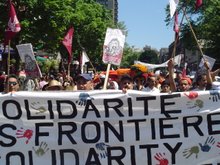
Par ailleurs, quelques personnes ont répondu à l'appel du Centre des travailleurs immigrants en manifestant mardi soir devant l'édifice où la Commission Bouchard-Taylor tenait son forum de citoyens. Leur porte-parole Jaggi Singh a fait valoir que la Commission a été créée sur une base xénophobe et raciste.

Plut tôt dans la journée de mardi, le réseau « Rejetons l'intolérance au Québec », qui coordonne les activités de nombreux groupes musulmans, a lui aussi fait valoir que la Commission Bouchard-Taylor a été créée sur de fausses prémisses, dénonçant ce qu'il appelle la manipulation politique faite autour du débat sur les accommodements raisonnables.

Carmen Chouinard, du Centre islamique libanais, considère qu'il n'y avait pas de crise des accommodements et le gouvernement Charest a agi par opportunisme. Elle ajoute que les travaux de la Commission sont dommageables puisqu'ils alimentent le racisme et la xénophobie.

Le Réseau « Rejetons l'intolérance au Québec » a prévu tenir des forums en parallèle aux travaux de la Commission Bouchard-Taylor.

http://www.radio-canada.ca/nouvelles/National/2007/11/20/004-forum-cote-des-neiges.shtml

Montreal accommodates panel's road show

Picketed outside by activists demanding jobs for immigrants, the Bouchard-Taylor commission on reasonable accommodation chose a highly symbolic site to hold its first Montreal open-mike night Tuesday.

The place was a new multi-ethnic library in Côte des Neiges/Notre Dame de Grace, a borough where almost half its residents are foreign-born.

But the subject on the lips of many of the 200 participants at the raucous two-hour meeting wasn't reasonable accommodations of religions. It was the bread-and-butter issue of language and employment.

"You f--ked me up here, and you f--ked up my country, too, and all the Middle East - you didn't give me a chance," complained Iranian immigrant Reza Koochekian Jaboor, 61, who said he hasn't found decent work in 22 years here because he doesn't speak French.

"Tu t'es trompw de province!" (You chose the wrong province!), a man heckled from behind him.

The evening at the Intercultural Library on Cote des Neiges Rd. was also disrupted briefly about half an hour in, as demonstrators picketing at the entrance started pounding on the window, whose blinds were drawn.

(As the meeting wound up, the 20 young activists also came in and unfurled a banner at the front of the room, chanting: "Immigrants in, racists out!")

The window-rattling briefly muffled a short speech by Amir Khadir, an Iranian-born doctor and co-spokesperson for the Quebec Solidaire political party, who said the province's economic development should not be done "on the backs of immigrants" who are jobless.

Quebec Immigration Minister Yolande James also attended the meeting but shied away from reporters, chatting instead with commissioners Gerard Bouchard and Charles Taylor before the meeting began.

For many in the crowd, the barrier of language - the French and English that immigrants have to know to work in the metropolis - was a constant theme. A French-Canadian man said he's disturbed that so many immigrants he sees on the bus speak English.

A Belgian immigrant said the contrary: He did a rough count at Cote Vertu métro station and saw "seven out of 10 commuters" reading Métro, the free French-language daily newspaper.

When it comes to equal-opportunity hiring, Tunisian immigrant Karim Rahmouni said, "Quebec shouldn't treat immigrants as handicapped" just because their French isn't up to snuff.

"I invite all immigrants to learn French," Pakistani immigrant Abdul Talib advised, saying that knowing the language of the majority is the best way to "integrate into the mosaic" that is Quebec and Canada generally.

Sibel Ataogul, a lawyer who immigrated here from Turkey when she was 9 years old, was applauded heartily after she proclaimed, "I learned French in eight months" and said immigrants adapt best to Quebec not by being coerced but by working hard.

Somalian refugee Farah Kulmijeh Abdil said learning French isn't an issue for him. "I'll never be Quebecois, because I'm black," he complained. "I'll always be asked, 'Where are you from?' "

Claude Dumont said he has asked Chinese immigrants in the neighbourhood why they speak English, not French. "They tell me there's not enough language training in French here," he said.

Mario Beaulieu, president of Mouvement Montreal francais, said English is the problem.

"If there's high unemployment (among immigrants), it's because they have to learn two languages, in addition to their own," he said.

In Montreal, "they can't get work if they don't understand English." And that, he said, is unacceptable.

Cote des Neiges and its sister community, Notre Dame de Grace, comprise one of Montreal's most heavily ethnic boroughs. Of a population of 172,000, more than 72,000 are immigrants; of those, 30,000 aren't Canadian citizens. The largest groups are Filipinos, Moroccans, Haitians and Chinese.

More than 40 per cent of residents speak English as their first language at home, compared with 30 per cent who speak only French and 25 per cent who speak another language.

Wednesday night, the Bouchard-Taylor commission moves to Sherbrooke for three sessions, returning to Montreal on Monday for a full week of hearings at the Palais des congres.

http://www.canada.com/montrealgazette/news/story.html?id=c217e4a2-f4b0-4420-b6f2-2a71a030605f&k=17735

Compounding immigration mess

Toronto Star
Nov 19, 2007 04:30 AM

Carol Goar

Canada has a backlog of 850,000 unprocessed immigration applications.

The federal government plans to admit a maximum of 265,000 immigrants next year.

It doesn't take a calculator to figure out that the pipeline will be clogged for years.

Even if Canada stopped accepting new applications – which it has no intention of doing – and Ottawa reached its immigration target – which it has seldom done – there would still be 585,000 applications in the queue.

Some of these people have been waiting for seven or eight years. Some have lost hope.

Either the governing Conservatives don't consider this a problem or they aren't prepared to spend the money to solve it.

Immigration Minister Diane Finley clearly knows how backed up the system is. Her annual report to Parliament – written by departmental bureaucrats – warns that the logjam is compromising service and eroding confidence in Canada's capacity to absorb newcomers. "Looking ahead, actions to control application intake and bring down the inventory are critical."

Yet in her introductory message, Finley merely thanked employees for their hard work and dedication. She ignored their plea for help.

Phil Mooney, president of the Canadian Association of Professional Immigration Consultants, says there is only one way to eliminate the backup: Admit more immigrants.

"We're set up for 265,000 people and we've got this mass of workers already in the system. All the department can do is whittle away at the edges and hope Parliament increases the number of people who can come in."

If Ottawa refuses to do that, Mooney says, three things will happen:

Migrants will apply for temporary work permits and stay in Canada illegally. "We'll become a guest worker society."

Applicants will jump the queue by getting provinces to nominate them. "They know they can get to the head of the line that way."

And employers will face acute labour shortages. "We need workers in large numbers in all categories and the system is not equipped to handle it."

The Conservatives didn't create this mess, but they compounded it.

Until 2002, the immigration backlog was small. That year, the Liberals introduced a stringent new set of entry criteria for skilled workers.

Hoping to beat the deadline, close to 500,000 people applied under the old rules.

To give them a fair chance, the government put in place a 12-month transition program, under which applicants could be assessed under either system. When it ended, there was still a sizable backlog so Denis
Coderre, the minister of the day, announced a three-month extension.

Then he cut it off. Close to 100,000 applicants, whose cases had not been adjudicated, got letters of rejection.

To Ottawa's dismay, they launched a class action suit – and won. A federal court judge ordered the government to assess the 100,000 applications under both the old and the new rules. He set a deadline of
September 2005.

It slipped by with many cases still unresolved.

The Conservatives added new pressures when they took office.

First, they ramped up Canada's temporary foreign worker program – once used primarily to bring in seasonal farm workers – creating a large influx of migrant manual labourers. Then they devolved responsibility for selecting immigrants to the provinces, creating 10 new entryways.

"If you wanted to create a backlog, you couldn't have done it better," Mooney says.

He sympathizes with the immigration officials. "They're good people facing mind-numbing challenges."

He gives them credit for getting some things right. "They do a fabulous job on children. You can usually get them in within three to six months. And they do a great job re-uniting spouses. That takes less than six months."

But people who apply as skilled workers – at a time when Canada urgently needs skilled workers – can expect to stand in line for years.

This country has a long tradition of welcoming newcomers. Immigrants built and shaped the Canada of today.

The Canada of tomorrow will need them even more.