Showing posts with label Detention. Show all posts

Friday, February 1, 2008

Five lost years

Andrew Duffy, The Ottawa Citizen- Published: Saturday, January 26, 2008 Photo: Nathan Denette, The Canadian Press

How Benamar Benatta 'disappeared' after 9/11. The Canadian government sent him to the U.S. where he was accused of being behind the 9/11 bombings: 'The way they accused me, I thought my life was over'

Toronto's Benamar Benatta calls himself a forgotten victim of Sept. 11.

Mr. Benatta, 33, a former Algerian air force lieutenant, also has the dubious distinction of being the first victim of Canada's sometimes overzealous security response to the U.S. terror attacks.

Former Ottawa engineer Maher Arar is the best known victim of Canada's post-9/11 national security excesses. A secretive federal inquiry is now exploring what happened to three other Arab Canadians -- Abdullah Almalki, Ahmad El-Maati and Muayyed Nureddin -- who, like Mr. Arar, say they were tortured in Syria based on faulty Canadian intelligence.

Mr. Benatta's plight predates the others, but remains little known. He has also been unsuccessful at winning an official review of his case.

So he has launched a $35-million lawsuit against the federal government for what he says was his illegal removal to the U.S. as a terror suspect one day after the World Trade Centre was levelled.

Initially, he was considered a potential conspirator in the attacks. And, although he was cleared of any connection to terrorism by November 2001, he would spend almost five years in U.S. custody, where he would suffer serious degradation and mistreatment, before being mysteriously returned to this country at the behest of Canadian officials.

"You just can't take somebody who's innocent and accuse him of being involved in the worst terrorist crime -- and then just close your hands and make like nothing happened," says Mr. Benatta, who now holds refugee status in Canada.

"I would like to have answers about why. Somebody out there owes me an apology. Canada just can't take an innocent person and send him away and forget about him for five years."

Mr. Benatta will visit Ottawa on Tuesday to relate his nightmarish saga to an audience at the Public Service Alliance of Canada Hall. The next day, he will march with supporters to the Prime Minister's Office to renew his demand for a public review of his case.

His story begins in Algeria where he was born on May 16, 1974, the youngest of 10 children. Mr. Benatta joined the military at 18, and after a year of basic training, was sent to university where he studied aeronautical engineering. After graduation, he returned to the military and taught aeronautics.

But Mr. Benatta says he became uncomfortable with the military crackdown in Algeria that followed the annulled 1992 general election won by an Islamist party.

"I opposed the methods employed by the military," he says. "There were civilians caught in the line of fire."

In December 2000, he travelled to the U.S. for training with a major U.S. arms contractor, Northrup Grumman. But Mr. Benatta had secretly decided to defect: he carried with him his life's savings and his university diploma. In April 2001, he abandoned his training program and fled to New York City.

Mr. Benatta, however, figured his chances of making a successful refugee claim were better in Canada, so in early September 2001, he made for the border.

"I had the impression that Canada had protection for human rights," he says.

At the Fort Erie border crossing, Mr. Benatta presented the false green card and social security card he had obtained in New York City. When an immigration official questioned him, he admitted they were fraudulent and claimed political asylum.

He was held in custody at the Niagara Detention Centre while Canadian immigration officials confirmed his identity. Mr. Benatta was in custody on Sept. 11 and remained unaware that the world had changed drastically that morning.

The next day, he was interviewed by two officials who did not identify themselves. According to Mr. Benatta, he was asked whether he could fly a plane -- he can't -- and about his military training.

Hours later, he was placed in the back seat of a car. Mr. Benatta thought he was going to a bigger detention facility in Toronto, but instead, he was driven across the Rainbow Bridge and handed over to U.S. officials.

Mr. Benatta insists he did not withdraw his refugee claim -- as Canadian officials would later contend -- and never acceded to his transfer to the U.S.

Indeed, he says he didn't realize he had crossed the border until he saw the uniforms on the men who took him into custody.

"No one told me we were going to the States whatsoever," he says. "They just put me in the back of the car."

Mr. Benatta first learned of the terror attacks on the evening of Sept. 12 during an interview with FBI investigators. He quickly realized he was being accused of participating in the deadliest attack on U.S. soil since Pearl Harbor.

"They said, 'If you co-operate now, we are going to give you a life sentence instead of death penalty,'" he says. "They did receive certain information that I am the one who trained the 19 people (hijackers) or orchestrated the Sept. 11 attacks. That's the information they give to me."

Four days later, Mr. Benatta was transferred to the Metropolitan Detention Centre (MDC) in Brooklyn, New York, where he was held along with 83 other "high interest" suspects in the FBI's investigation of the Sept. 11 terror attacks. Most of the men had been detained on the strength of various immigration offences.

Mr. Benatta was held incommunicado and denied access to a lawyer; his family in Algeria thought he had disappeared.

Mr. Benatta says he repeatedly had his head slammed against the wall by MDC guards, who also shackled his legs painfully tight. He was left outside in the cold and punished for speaking to other prisoners by being denied food. The lights in his cell were kept on for 24 hours a day.

(Mr. Benatta's description of his abuse is consistent with the findings of a report by the U.S. Justice Department's Office of the Inspector General, which issued a damning assessment of the Brooklyn detention centre in December 2003. The U.S. Justice Department uncovered a videotape that, among other things, recorded repeated and degrading strip searches. The report recommended disciplinary action against 10 individuals for their "abusive" behaviour.)

Mr. Benatta was repeatedly interrogated by FBI agents assigned to the Terrorism Task Force.

"The way they accused me, I thought it was over," he says. "I thought they didn't find nobody who did it and they were just going to accuse me. They would present me to the people that I was the one who did it. I thought that was it: I thought my life was over."

But on Nov. 15, 2001, according to evidence later made public in U.S. District Court, the FBI officially cleared Mr. Benatta of any connection to terrorism.

Yet Mr. Benatta continued to be held in detention. He was subsequently charged with being in possession of false identification: his phony green card and social security number.

He remained incommunicado at the Brooklyn detention centre until April 30, 2002, when he was transferred to a jail in Buffalo, New York, and finally allowed access to a lawyer.

Two years after first being detained, Mr. Benatta's criminal case went before U.S. District Court Judge Kenneth Schroeder, who castigated federal prosecutors for their legal "shams" and "ridiculous" delays. The judge said Mr. Benatta had been denied his right to a fair and speedy trial.

Based on a recommendation from Judge Schroeder, the criminal charges against Mr. Benatta were dropped in October 2003.

But Mr. Benatta's ordeal was not over. Since he still did not have legal standing in the U.S., he applied for political asylum; he was kept in immigration detention because U.S. officials considered him a "flight risk."

After his bid for asylum was denied on April 7, 2004, he launched an appeal. He was told he could be released if he posted a $25,000 bond, but Mr. Benatta knew no one with that kind of money in the U.S.

His appeal was denied in September 2004, which meant that Mr. Benatta faced the terrifying prospect of being returned to Algeria. He believed that as a military defector, he would be imprisoned and tortured if sent back.

He appealed his deportation and won a stay of that order in January 2005, but he was not released from custody.

It was about this time that Janet Dench, director of the Canadian Council for Refugees, heard about his ordeal and began to work for Mr. Benatta's return to Canada. The Benatta case had been brought to the attention of the United Nations by the American Civil Liberties Union; his plight had also been written about by the Washington Post.

Ms. Dench began to lobby the Canadian government to recognize its critical role in the case and to make things right for Mr. Benatta.

Canada, she told federal officials, had no legal basis for removing Mr. Benatta and had a moral duty to rescue him from U.S. custody.

"It's extremely, extremely disturbing when you find officials violating the law," she says. "It's one of the most basic things you expect: that the basic requirements of the law will be followed by our officials.

"And in many ways, it's worse when it happens in the heat of the moment, on the 12th of September, because that's exactly when you need laws to be scrupulously respected."

After what she describes as a "long, slow process," Ms. Dench's representations gained traction in Ottawa.

On July 11, 2006, the Canadian government sent the U.S. Department of Homeland Security a curious letter.

Written by a Canadian consulate official in Buffalo, the letter announced that Canada would offer Mr. Benatta a temporary resident permit to allow him re-entry into this country.

In his letter, obtained by the Citizen, Consul Randy Orr confirmed that Mr. Benatta had been detained in Canada on Sept. 5, 2001. His immigration file indicates that Mr. Benatta expressed a desire to seek refugee status in Canada, Mr. Orr said, noting there is no record of such a claim.

"On September 12," Mr. Orr wrote, "Mr. Benatta was returned to the United States. Information on the file indicates this was a voluntary withdrawal. However, there is no documentation to support this, such as a copy of the 'Allowed to Leave' form, as would normally be the case."

Ms. Dench says Canadian officials should be given full credit for coming to Mr. Benatta's aid. "It certainly wasn't a full restitution," she says, "but at least they had the guts to take some action to get him out of detention."

Dressed in a prison jumpsuit and shackled, Mr. Benatta was driven back across the border to Canada on July 20, 2006.

Chris Williams, a spokesman for the Canada Border Services Agency (CBSA), said he could not comment on the Benatta case because it's before the courts. He refused to say if the federal government continues to believe that Mr. Benatta willingly went to the U.S. "We're currently reviewing the allegations and examining the claim," Mr. Williams said.

Mr. Benatta's lawyer, Nicole Chrolavicius, says the Canadian government bears some responsibility for what happened to him.

"They were the instigators of the whole event," she says. "They identified him as a suspect in the Sept. 11 terrorist attacks and then handed him over without any legal process whatsoever."

Mr. Benatta's case must be fully explored, Ms. Chrolavicius contends, because it stands as the first example of how the Canadian government moved "outside the law" after the terror attacks in New York and Washington.

"He was lifted completely out of the immigration realm, completely out of any thought of extradition, for example, lifted outside of any legal process and stuck in the back of a car and driven over the border," she says. "He was not deported, or removed, or refouled. He was transferred outside the scope of any lawful authority ...This was an illegal rendition."

Mr. Benatta's lawsuit alleges that Canadian officials later attempted to cover-up their misconduct by falsely suggesting that Mr. Benatta withdrew his refugee claim in Canada. The allegations in the lawsuit must be proven in court.

The federal government has yet to file a statement of defence in the case and is attempting to have the matter moved to Federal Court.

For his part, Mr. Benatta wants answers to some fundamental questions. Why was he sent to the U.S. without due process? What did Canadian security officials tell their U.S. counterparts about him? Why did Canadian officials act so rashly when he was already in custody? Why didn't Canadian security agencies do their own assessment of his alleged connections to 9/11? Why did the Canadian government not seek his return until 2006?

"Why throw me in the car like a package and deliver me like I'm nobody?" he asks.

Mr. Benatta now lives on social assistance in Toronto. He has been unable to get work, he says, because his name has been tied to terrorism. He also finds it hard to explain the five-year gap in his resume. He holds out little hope of resuming his career as an aeronautics engineer.

In November, Mr. Benatta finally won his claim for refugee status in Canada -- a milestone he regards as bittersweet.

"After seven years of fighting, that was a relief. I am very grateful to Canada to be provided protection here," he says. "But I can't get on with my life. Not yet."

http://www.canada.com/ottawacitizen/news/observer/story.html?id=6cfbd053-d721-4146-9cb9-3e02e1558093&p=1

Les tribunaux se pencheront sur les certificats de sécurité

Le mercredi 30 janvier 2008

Mohammed Harkat (Photo PC)
Agrandir l'image
Mohammed Harkat
Photo PC
Presse Canadienne
Les certificats de sécurité qui permettent de détenir indéfiniment et sans procès des personnes soupçonnées de terrorisme seront à nouveau débattus devant les tribunaux, jeudi à Ottawa.

La Cour suprême se penchera en effet sur le cas du Montréalais Adil Charkaoui, qui reproche notamment aux services secrets d'avoir détruit les enregistrements de certains interrogatoires auxquels il s'est prêté, d'avoir mené une enquête biaisée et d'avoir omis de présenter certains éléments de preuve au ministre de l'Immigration qui émet les certificats.

L'enseignant d'origine marocaine estime que ces manquements justifient la révocation du certificat dont il est l'objet depuis 2003 et qui lui a valu 21 mois de détention.

La Cour fédérale, qui siège dans le même édifice, entendra pendant ce temps les avocats de Mohammed Harkat, qui a été arrêté mardi, alors qu'il prenait sa douche chez lui. Le ressortissant d'origine algérienne était en liberté surveillée depuis 2006.

Depuis sa sortie de prison, il doit notamment porter un bracelet électronique et être accompagné en tout temps de sa femme, de sa belle-mère, ou d'un autre gardien autorisé.

Les motifs de son arrestation demeurent flous, mais les autorités ont laissé entendre qu'il n'avait pas respecté toutes les conditions que lui avait imposées le tribunal. Ses proches soutiennent pour leur part qu'il est victime de harcèlement.

«Nous considérons que cette arrestation est un prétexte, un moyen d'entretenir l'hystérie contre le terrorisme au Canada.

Ça sert de justification au gouvernement pour adopter une nouvelle loi injuste», a insisté un ami de la famille Harkat, Christian Legeais.

M. Legeais était au Parlement mercredi en compagnie de proches des cinq hommes musulmans visés par des certificats de sécurité et du président du Conseil musulman de Montréal, l'imam Salam Elmenyawi.

Lors d'un point de presse auquel assistait Adil Charkaoui, ils ont officiellement demandé aux députés de tous les partis de voter contre le projet de loi C-3, qui modifie le régime des certificats de sécurité, jugés inconstitutionnels en février dernier.

La loi prévoit entre autres la nomination «d'avocats spéciaux» comme cela se fait déjà en Grande-Bretagne. Ces procureurs auraient accès au dossier secret du présumé terroriste et pourraient donc mettre en doute la pertinence et l'importance des faits allégués lors d'audiences à huis clos. Il ne pourrait cependant discuter de la preuve avec personne, pas même son client.

D'après les proches des personnes visées par des certificats, les changements proposés sont insuffisants et perpétueraient l'injustice et le racisme. «On ne veut pas une justice à deux vitesse», a insisté la mère d'Adil Charkaoui, Latifa Charkaoui.

À l'instar de groupe de défense des droits humains, les proches des personnes visées par un certificat veulent la disparition pure et simple de cette procédure.

Ils affirment qu'on devrait traiter les présumés terroristes «comme des citoyens canadiens» et leur faire un procès formel au lieu de les enfermer sans même leur dire ce qui leur est reproché.

Le Bloc québécois et le Nouveau Parti démocratique ont déjà laissé savoir qu'ils s'opposeraient à la nouvelle législation telle que formulée. Le sort du projet de loi dépend donc du Parti libéral qui n'a pas encore fait connaître sa position.

L'ancien régime disparaîtra automatiquement le 23 février prochain, qu'Ottawa ait réussi à le remplacer ou pas.

http://www.cyberpresse.ca/article/20080130/CPACTUALITES/80130226/1019/CPACTUALITES

Liberté conditionnelle rompue pour un présumé terroriste algérien

Le mardi 29 janvier 2008

Mohamed Harkat. (Photo PC)
Agrandir l'image
Mohamed Harkat.
Photo PC

Agence France-Presse
Ottawa
Un Algérien soupçonné de terrorisme a été remis en détention, après avoir été accusé d'avoir contrevenu aux termes de sa libération conditionnelle, a indiqué son avocat à l'AFP.
Click here to find out more!


À consulter aussi
Lisez d'autres articles sur ces sujets :

Peines (88%)

Prison (87%)

Mohamed Harkat (84%)

Actes de terrorisme (76%)

Agence France Presse (75%)

Me Paul Copeland (71%)


Mohamed Harkat a été arrêté chez lui mardi après-midi et emmené dans les locaux de l'agence canadienne des services frontaliers, à Ottawa, d'où il devait être placé dans un centre de détention, en attendant une décision de justice à son sujet, a déclaré Me Paul Copeland à l'AFP.

Il doit être présenté, dans un délai de 48 heures, à un juge de la Cour fédérale qui décidera de son sort.

Selon son avocat, la principale violation qui lui est reprochée est le fait que sa belle-mère, qui est une des garantes du respect des conditions de sa liberation, n'habitait plus en permanence dans la même maison que lui et sa femme.

M. Harkat n'avait cependant jamais été laissé seul dans la maison, a assuré Me Copeland.

«Sa femme était avec lui à la maison lorsqu'il a été arrêté, alors qu'il prenait sa douche», a-t-il dit.

L'avocat avait par ailleurs prévu, avant même l'arrestation de son client, de présenter lundi prochain une demande au tribunal pour que les conditions de sa libération soient assouplies afin de permettre à sa famille de mener une vie normale.

Mohamed Harkat avait été arrêté en décembre 2002 en vertu d'un «certificat de sécurité», une procédure qui permet aux autorités de détenir sans procès des étrangers soupçonnés de terrorisme sur la base d'informations secrètes.

Il avait obtenu en juin 2006 sa libération conditionnelle, mais devait porter un bracelet électronique, demeurer sous la supervision de son épouse ou d'autres membres de la famille et demander l'autorisation pour effectuer des déplacements ou rencontrer une personne.

Mohamed Harkat est soupçonné par le Service canadien de renseignement et de sécurité (SCRS) de faire partie d'une cellule dormante d'Al-Qaeda.

http://www.cyberpresse.ca/article/20080129/CPACTUALITES/801291681/5032/CPACTUALITES

Sunday, November 11, 2007

Video: Dentention Centre protest

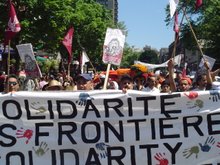
People in support of immigrants are spending Saturday night outside the Immigration Detention Centre in Laval.

They've built a protest camp outside the centre on Montee St. Francois to demand its closure. They also want an end to all deportations.

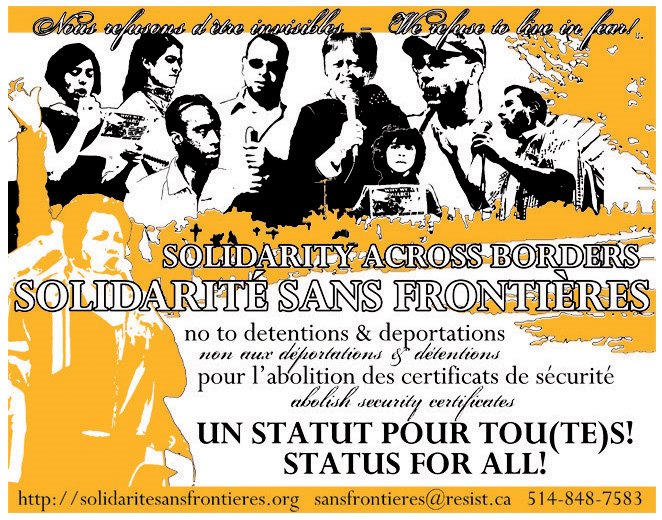
"We're actually opposed to the existence of a detention centre as such," said Poya Saffari of Solidarity Across Borders. "The reasons for which people are detained we find illegitimate, for example for coming on a fake passport."

The protesters are also refusing to recognize international borders. They want the united

To view video click HERE

On réclame la fermeture du Centre de prévention de Laval

Ils étaient au moins une centaine de manifestants à scander à pleins poumons devant le Centre de prévention de l'immigration de Laval: «Personne n'est illégal.» Ils n'exigent rien de moins que la fermeture de cet établissement et la libre circulation des immigrants.

La porte-parole des militants pour les droits des immigrants, Émilie Bréton, explique qu'en enfermant les gens qui demandent l'asile au Canada, on les traite comme des criminels. Quelque 1 800 personnes sont séquestrées dans cette «prison» chaque année.

«Il y en a qui sont détenus durant des mois, voire plus d'un an, souligne Mme Bréton. Ils ne peuvent sortir de là durant leur séjour. Ils n'ont aucun papier leur permettant de circuler à l'extérieur.»

Dans le Centre de Laval, qui peut accueillir environ cent personnes, les hommes et les femmes vivent séparément, les enfants avec ces dernières. Ils dorment dans des dortoirs d'environ quinze places et mangent en groupe. C'est inhumain pour les familles avec des enfants, selon elle.

Une prison

Saeid Rivan, un immigrant d'origine iranienne de 42 ans, corrobore ses dires. Arrivé au Canada en 1999, il attend toujours sa naturalisation.

«J'ai passé quatre mois et demi dans ce centre de détention, dit-il. C'est comme une prison avec une discipline de fer. On nous isole au moindre manquement. Il a fallu que je dépose un cautionnement de 3 000 $ avant de reprendre ma liberté.»

Pas de camping

Les militants qui prévoyaient passer la nuit sous la tente sur le terrain de l'établissement ont vu leur projet tomber à l'eau lorsque les policiers leur ont annoncé qu'ils n'avaient par la permission des autorités.

Les manifestants, membres d'une coalition réunissant, entre autres, Solidarité sans frontières et Bloquez l'Empire, tenaient également à dénoncer les murs élevés aux frontières entre les États-Unis et le Mexique, et en Palestine par Israël.

http://www2.canoe.com/infos/quebeccanada/archives/2007/11/20071111-094300.html

Manifestation contre la détention des immigrés

Catherine Handfield

La Presse

«Vous êtes détenus et nous sommes contre ça. Aujourd'hui, nous ne sommes pas capables de vous libérer. Mais un jour, nous pourrons vous libérer.»

Le militant Jaggi Singh a voulu lancer un message d'espoir, hier. Armé d'un micro branché à deux immenses haut-parleurs, il s'est adressé aux immigrés détenus au Centre de prévention de l'immigration de Laval. Là même où l'imam Saïd Jaziri a été détenu avant son expulsion en Tunisie, le mois dernier.

Une soixantaine de militants

Une soixantaine de militants s'y étaient donné rendez-vous en début d'après-midi. Le but de l'action: exiger la fin de la détention des immigrés, la libre circulation des personnes et un statut pour tous.

Le plan initial était de camper dans le stationnement jusqu'à ce matin mais, au moment de mettre sous presse, le groupe ne savait toujours pas s'il allait passer la nuit sur place. «Quand nous sommes arrivés, les policiers avaient déjà érigé un périmètre de sécurité devant le stationnement», a dit Poya Saffari, du groupe Solidarité sans frontières.

Les militants bien emmitouflés sont donc restés en bordure de la montée Saint-François, à 50 mètres du Centre. Les policiers leur ont interdit de faire des feux et de monter leurs tentes. Un froid mordant était également de la partie.

Le groupe a tout de même pu entrer en contact avec six «détenus préventifs», hier. Jaggi Singh leur avait transmis un numéro de cellulaire à l'aide des haut-parleurs. Ils ont téléphoné dès qu'ils ont été autorisés à le faire.

Le Polonais Pierre Kodecki a sauté sur l'occasion. L'homme de 54 ans est au Centre depuis lundi et devra y rester pour au moins 10 jours encore. Il affirme avoir omis de signaler un changement d'adresse le mois dernier. «On ne peut pas enfermer quelqu'un comme ça pour une simple erreur administrative, a-t-il rugi. C'est un crime.»


Un geste de solidarité


L'action d'hier était organisée par plusieurs groupes de défense des droits des immigrés. Il s'agissait d'un geste de solidarité avec des centaines de Mexicains qui, depuis cinq jours, campent à Calexico, au Mexique, à la frontière des États-Unis, pour demander la libre circulation entre les deux pays.

«Les réfugiés se sauvent des conditions que nous, les pays occidentaux, avons créées en exploitant leur économie. Et qu'est-ce que nous faisons? Nous les expulsons quand ils viennent ici. C'est vraiment sale», s'est désolée la militante Maude Prud'homme.

Le Canada a renvoyé 12 617 personnes l'année dernière, selon le rapport annuel de l'Agence des services frontaliers. Il s'agit d'une forte augmentation depuis 2001, alors qu'il y avait eu 9165 renvois.

Au Centre de prévention de l'immigration de Laval, «les immigrants sont détenus à titre préventif pour identifier, protéger la santé et la sécurité du public ou pallier à un risque de fuite», a expliqué hier Érik Paradis, porte-parole de l'Agence des services frontaliers du Canada. Une trentaine de personnes y étaient détenues, hier.

http://www.cyberpresse.ca/article/20071111/CPACTUALITES/711110449/5358/CPPRESSE

Wednesday, October 17, 2007

Migrants arrested near Quebec-Vermont border

From Wednesday's Globe and Mail

MONTREAL — More than 40 South American asylum seekers have been arrested in the past week near the Quebec-Vermont border in what an official said was a crackdown against an unusual surge in illegal immigration.

"This is a major spike in the number of people crossing illegally. It's a significant number," said Dominique McNeely, a spokesman for the Canada Border Services Agency.

Four of those arrested were charged: two for smuggling people and two for being in Canada illegally, Mr. McNeely said.

Most of the 43 people apprehended are from Colombia, and some are Venezuelans, said Claire Desgens, a Sherbrooke legal-aid lawyer contacted by the newcomers.

One of the four people charged is a U.S. citizen, and another is a Colombian with permanent residency status in the United States.

The arrests were made by CBSA and the RCMP around Stanstead, a small town sitting right on the border, 165 kilometres southeast of Montreal.

The majority of the 43 have been released and, having applied for refugee status, are now in the Montreal area awaiting a hearing before the Immigration Refugee Board, Ms. Desgens said.

Mr. McNeely said the migrants entered via unguarded roads around Stanstead in Quebec's Eastern Townships.

An immigration agent who testified at the bail hearing of one of the four accused said the authorities believe that the refugee claimants might have received bad advice.

Ms. Desgens noted that, in many cases, people who are portrayed by immigration officials as smugglers are, in fact, relatives living in the United States who were accompanying the asylum seekers.

http://www.theglobeandmail.com/servlet/story/RTGAM.20071017.wborder17/BNStory/National/home

L'imam Jaziri hospitalisé

 (Photo La Presse)
Agrandir l'image

Photo La Presse

Martin Croteau

La Presse

L'imam Saïd Jaziri a été hospitalisé tard hier soir après avoir entamé une grève de la faim pour contester son arrestation et son expulsion prochaine vers la Tunisie.

L'imam aurait cessé de s'alimenter et de boire depuis plus de 30 heures, selon sa conjointe, Nancy Adams. M. Jaziri devait comparaître ce matin mais l'audience pourrait être reportée à cet après-midi.


À cause de ses opinions


C'est à cause de ses opinons controversées, et non à cause d'un dossier criminel vieux de 17 ans, que Saïd Jaziri estime avoir été emprisonné par les autorités canadiennes.

Arrivé au Canada en 1997, M. Jaziri a fondé la mosquée Al-Qods, dans le quartier Rosemont. Il s'est fait connaître pour ses positions favorables à l'instauration de tribunaux de la charia. En entrevue, il a maintes fois mentionné que l'homosexualité est un péché.

L'Agence canadienne des services frontaliers l'a arrêté lundi lorsqu'il s'est présenté à un rendez-vous de routine. Les autorités l'accusent d'avoir caché l'existence d'un casier judiciaire en France, où il a séjourné avant d'immigrer au Québec.

Joint par téléphone au Centre de prévention de l'immigration de Laval, Saïd Jaziri n'en démord pas: les autorités de l'immigration cherchent un moyen de l'expulser depuis des années. «Le Canada s'acharne sur moi parce que je parle, parce que je m'exprime, proteste-t-il. L'histoire du casier judiciaire date de 17 ans. La France a tout pardonné. J'ai eu un pardon il y a des années.»

L'imam de 40 ans dit qu'il risque la torture s'il est renvoyé dans son pays d'origine. Il rencontrera ce matin un commissaire à l'immigration pour déterminer s'il restera détenu jusqu'à son expulsion. D'ici la fin de la procédure, il entend refuser toute nourriture et toute boisson.

Sa conjointe, Nancy Adams, enceinte et diabétique, avait passé les derniers jours en sa compagnie. Mais elle a dû quitter la prison de l'immigration, souffrant d'un malaise.

Saïd Jaziri ignore à quel moment il doit être expulsé, mais il garde espoir de voir les autorités canadiennes revenir sur leur décision. Il affirme avoir reçu l'appui de dizaines de Québécois, y compris bon nombre de «pure laine».

«C'est une décision politique. Moi, je fais appel à la générosité des Québécois. Jamais je n'ai détesté ce peuple et ce pays. Ma femme est québécoise, j'en suis fier. Mon fils sera québécois, il a le sang du Québec et j'en suis fier.»

http://www.cyberpresse.ca/article/20071017/CPACTUALITES/710170553/5358/CPPRESSE

Montreal imam arrested, faces deportation

Imam Said Jaziri, who will appear before the immigration board on Wednesday, Oct. 15, 2007.

Imam Said Jaziri, who will appear before the immigration board on Wednesday, Oct. 17, 2007.

The Al Qods mosque in northeast Montreal, where Said Jaziri practices as an imam.

The Al Qods mosque in northeast Montreal, where Said Jaziri practices as an imam

CTV.ca News Staff

A Montreal imam who allegedly lied about his criminal status will appear before an Immigration and Refugee board on Wednesday. His pregnant wife says he faces death if deported back to his native Tunisia.

"It's not just an impression I have, it's a certainty," imam Said Jaziri's Canadian-born wife, Nancy-Ann Adams, told reporters. "There's no doubt about it."

Jaziri was taken into custody Monday by Canada Border Services Agency officials, under the Immigration and Refugee Status Act.

The imam had gone to a meeting at one of the agency's offices, according to spokesperson Kareen Dionne. His wife -- who is eight-months pregnant -- witnessed the arrest.

"I have diabetes -- type 1 -- so this is dangerous for me and the life of my child," she told CTV Montreal by phone.

"My husband is not here. Who is going to care for me? Who is going to help me now?"

The imam will be held at a detention centre in Laval until he appears before the board.

Adams said Jaziri isn't a flight risk, and will be tortured to death if deported back to the country of his birth.

Dionne would not divulge details about Jaziri's case, but said that during Wednesday's hearing the agency will reveal why it thought his detention was necessary.

"Generally, the motives that are invoked to ask for the detention of an individual is based on the risk of that individual not showing up either for an audience review or for the removal process," she told The Canadian Press.

The board revoked Jaziri's refugee status last December, which he had obtained several years earlier in 1998.

Jaziri then took refuge inside the Al Qods mosque in northeast Montreal, where he acts as imam. He took the same action in 2005, when he first heard officials were trying to revoke his status.

The board alleges Jaziri never mentioned he had a criminal record in France, and that he exaggerated the risks he faces if he returned to Tunisia.

But Jaziri has said his criminal record was expunged after he helped French security forces, and the threat of torture and death in Tunisia is only too real.

He tried to reclaim his refugee status by taking his case to the Federal Court and the Quebec Court of Appeal, but those attempts have so far failed.

One of the members of his mosque, Mohammed Alaoui, urged Montreal's Muslims to throw their support behind Jaziri.

"He's a man who tells the truth, the whole truth," said Alaoui.

Jaziri, a well-known imam in Montreal, had planned on creating a massive mosque in the city.

Nearly two years ago, he led a local protest, criticizing cartoons that depicted the Prophet Muhammad in a Danish newspaper.

Muslims are strictly forbidden from illustrating Muhammad.

http://www.ctv.ca/servlet/ArticleNews/story/CTVNews/20071015/montreal_imam_071015/20071015?hub=Canada

Tuesday, October 9, 2007

Miscommunications led to arrest, American refugee advocate says

MONTREAL-Cracking down on refugee advocates is unlikely to stop an influx of refugees at the Canadian border, says an American immigration consultant who was arrested last month at the Quebec-New York state border and charged with human smuggling.

Janet Hinshaw-Thomas, a 65-year-old refugee advocate from Chester, Pa., says perhaps some humanitarian organizations who previously thought they could operate without fear of legal reprisal will think twice before helping people who are seeking asylum in Canada.

But with the current immigration situation in the United States, people will continue making a bee line for the Canadian border, with or without the help of intermediaries.

"I can't believe that people are not going to approach the border, they'll just pay other people to get up there," said Hinshaw-Thomas in an interview last week, between seeing clients at her offices in Lancaster, Pa.

"It's not going to stop it, but it's going to stop an orderly process."

There has been a recent influx of Mexican and Haitian refugees in Windsor, Ont., from the United States where the Immigration and Naturalization Service are in the midst of a clampdown on illegal immigrants.

"The deportations in the United States of Haitians as well as other people have gone up tremendously and people are living in great fear," Hinshaw-Thomas said.

Hinshaw-Thomas, who was arrested on Sept. 26 in Saint-Bernard-de-Lacolle, Que. as she helped 12 Haitian nationals cross the border, says a series of miscommunications on both sides led to her arrest. In 19 previous trips by people from her organization, no one had ever been arrested or stopped.

Her supporters say Canada is targeting a Good Samaritan, using a provision under Canada's Immigration and Refugee Protection Act designed to stop criminal organizations involved in people smuggling.

Her lawyers are confident they can beat the charges, but there is an underlying issue.

"People (humanitarian workers) are very afraid right now and they all think they could be next," said one of Hinshaw-Thomas's Montreal-based lawyers, Mitchell Goldberg. "We don't think it's enough to drop the charges .... we are calling for guidelines to be issued so this never happens again."

Hinshaw-Thomas says on one of her trips she was shown the law and her entire understanding of Sec. 117 was that humanitarian workers are allowed to assist the asylum seekers as long as they don't profit from it.

"In retrospect, the Canadian law is much more encompassing," said Hinshaw-Thomas. "I didn't have to earn a penny or lose a penny for me to be charged. I certainly did not understand it. It was never my intention to violate Canadian law."

The legislation has severe penalties of a maximum of a $1 million fine and/or life in prison.

Hinshaw-Thomas is believed to be the first human rights worker to be charged under the act and is due back in court in Saint-Jean-sur-Richelieu on Nov. 30.

The good-natured grandmother of four admits she's a little daunted by her situation.

"It is a bit scary, I don't relish life imprisonment," she said.

Janet Dench, executive director of the Canadian Council for Refugees, says there is a grassroots movement moving towards putting pressure on the government.

"I've seen people are more outraged and they are trying to find ways to confront the government on this and to challenge the government on the prosecution of people who are helping refugees on a humanitarian basis," Dench said.

"I think most people interpret it as (the government) wanting to send a message. It creates a very confrontational position."

Erik Paradis, a Canada Border Services Agency spokesperson, said profit has nothing to do with the arrest.

"The person that was charged was very well aware of the consequence of such activities, she had been notified previously so this why we took this stance and pressed charges," Paradis said.

Paradis said officers applied the law as it is laid out. As a safeguard that humanitarian workers aren't abused, there is a provision that states the attorney general's consent must be included on any warrant.

"Its up to the court to determine if our officers applied the act correctly," Paradis said. "Maybe we'll have a surprise and realize we shouldn't have, but we really applied the act and the attorney general agrees with us."

Federal Justice Minister Rob Nicholson told The Canadian Press last week he did not personally sign any warrant or authorization calling for the arrest of Hinshaw-Thomas, and as per policy, would not comment on the particular case.

"I will say that the law is clear that anyone who aids or abets individuals entering in this country without proper documentation is subject to a charge under the immigration and refugee act and the law is clear," Nicholson said.

http://canadianpress.google.com/article/ALeqM5jBqJlid57wQvHssKiTWZcPabsPdg

Migrants face prison in U.S., lawyer says

The Windsor Star
Thu 04 Oct 2007
Byline: Don Lajoie
Source: Windsor Star

With the mayor's office announcing that the number of refugee claimants from Florida seeking Windsor city services has now reached 276, an American immigration lawyer is warning illegal immigrants seeking asylum here they could face prison if returned to the U.S.

Speaking at a news conference called Wednesday by the Detroit refugee aid agency Freedom House to clear its name in connection with the current refugee crisis swamping Windsor, immigration lawyer Noel Saleh said the situation facing the estimated 300 illegal Mexican and Haitian immigrants believed to have crossed into Canada is more dire than most may realize.

"Because of bad information they received from unscrupulous operators, it's highly likely their refugee applications will be denied in Canada," he said.

"Many may be returned to the United States to face triple jeopardy."

He said that's because many failed applicants may be sent back to the U.S. as the country of entry, where they could then be turned over to American immigration authorities and held in custody pending deportation to their country of origin, be that Mexico or Haiti.

In a worst-case scenario, he added, an illegal immigrant re-entering the U.S. without advance permission could be subject to federal charges. If convicted, they could face two years in a federal prison and then be deported.

Those found to have sought illegal entry twice could be convicted as felons and serve 10 years before deportation.

"Many only hoped and wanted to believe a myth that there was a program of economic asylum available in Canada," said Saleh. " But there's no such project.... And they could now face the risk of criminal charges."

He said it is important that like-minded illegals still living in the U.S. get the message that Canada's border is not open and that they should avoid being victimized by "misrepresentation or unscrupulous" immigration consultants like those alleged to have sent hundreds fleeing a rumoured immigration crackdown in Florida.

"Don't put yourselves in the same jeopardy that the first wave now faces," he warned.

Pegg Roberts, executive director of Freedom House, distanced her organization from the influx of migrants at the Canadian border, saying the group has no affiliation or relationship with the Jerusalem Haitian Community Centre, the consultants blamed for beginning the mass exodus.

Jacques Sinjuste, director of the JHCC, attempted to link his organization to Freedom House during a recent visit to Windsor by providing copies of letters and electronic communications between the two organizations as evidence a relationship existed.

But Roberts said that Canadian refugee information was likely down-loaded from the Freedom House website by the JHCC and, in cases where the refugees had a strong case, Freedom House would contact the applicants "to tell them an appointment had been set up" for them with Canadian authorities.

"But we had no direct contact with JHCC," said Roberts, adding she is unsure why Freedom House ever appeared on the organization's website.


Wednesday, August 22, 2007

Paralyzed refugee claimant gets 60-day stay of deportation

Canadian Press


The federal government has granted a 60-day stay of a deportation order to a paralyzed Indian refugee claimant who was to have been removed from Canada on Monday.

Supporter Harpreet Singh says Laibar Singh is happy to be remaining in Canada for now.

The Sikh community asked people to e-mail the immigration minister as well as Minister of Public Safety Stockwell Day, and thousands of e-mails were sent, he said.

More than a dozen politicians and community leaders also urged the federal government to allow Laibar Singh to stay in Canada.

Since July, Laibar Singh has lived in sanctuary at a Sikh temple in Abbotsford, east of Vancouver.

He left his safety zone Monday to seek treatment at a hospital, where he was arrested.

His lawyer, Zool Suleman, wants his client to be allowed to stay on humanitarian grounds. Suleman said if his client is deported back to India, his health will be in danger.

The lawyer says Singh has no one to care for him in India and doesn't have money to support himself there.

Harpreet Singh said Laibar Singh will be returning to the temple and that his health expenses will be borne by the local Sikh community.

http://www.cbc.ca/canada/british-columbia/story/2007/08/19/deport-refugee.html

Friday, August 17, 2007

Ottawa rejected Guantanamo refugees, reports show

JENNIFER DITCHBURN
Canadian Press
The Globe and Mail
http://www.theglobeandmail.com/servlet/story/LAC.20070816.ASYLUM16/TPStory/National

August 16, 2007

OTTAWA -- The Canadian government balked at several requests from Washington to provide asylum to men cleared for release from the U.S. military prison in Guantanamo Bay, newly released documents say.

The material, obtained by The Canadian Press under access-to-information legislation, indicates the Bush administration asked Canada to accept detainees of Uyghur descent from China's Xinjiang region who were deemed to be no threat to national security.

The United States was not prepared to resettle the men in its own territory, but could not send them back to China for fear that they would be persecuted. Canada seemed ill at ease with taking on refugees to remedy a massive public-relations headache for its southern neighbour. Today, 17 of the men are still being held and live in isolation for 22 hours a day.

"Canadian officials indicated to the U.S. delegation that the men would likely also be inadmissible under Canadian immigration law, requested the exact ground for ineligibility to enter U.S. territory," according to a Foreign Affairs briefing note prepared about a meeting last May.

U.S. officials travelled to Ottawa on three separate occasions in late 2005 to press their case with the Liberal government. By May, 2006, Washington had persuaded Albania to take five men, who now live in squalid conditions.

A week after the transfer to Albania, the Americans were back in Canada meeting with both political aides and bureaucrats from several departments and Prime Minister's Stephen Harper's office.

Under the Canada-U.S. Safe Third Country Agreement, refugees cannot make claims to enter Canada from the United States except in exceptional cases, such as fear they would face the death penalty in the United States.

Notes prepared for then-foreign-affairs-minister Peter MacKay in February suggest the government was still uncertain about whether it had the appetite for any future transfers.

"There has been no final decision by the Government of Canada as to whether to formally discourage or encourage the U.S. from making formal referrals for resettlement. ... [Foreign Affairs] will need to consider the bilateral and multilateral implications."

One of those implications could be Canada's relationship with China. News reports in the United States said Beijing urged several countries not to take the Uyghurs, although there is no suggestion Canada was in that group.

Mr. Harper has criticized China's treatment of a Canadian citizen of Uyghur origin, Huseyin Celil, who has been sentenced to life in prison. China has cracked down on Uyghur dissidents from Xinjiang, an area rich in oil and gas.

Chinese agents were allegedly allowed into Guantanamo to interview the detainees, and Chinese officials want Washington to ship them to Beijing.

The 22 men were transferred to U.S. custody by Pakistani bounty hunters after the terrorist attacks of Sept. 11, 2001. Several of the Muslim men maintain that they were en route to Iran and Turkey to seek refugee status.

Mohamed Tohti, president of the Uyghur Association of Canada, argues that if Canada wants to force China to negotiate on Mr. Celil's case, it would rapidly gain Beijing's attention by taking in Uyghur refugees.

"The worst has already happened - Celil has been sentenced to life in prison," Mr. Tohti said in an interview. "So you have to make waves to make the Chinese government come to the table."

Amnesty International Canada has also pressed Canada to take the Guantanamo Uyghurs.

Suspect Anything? Religious profiling by Canadians lands asylum-seeker in custody

By MIHAD FAHMY, GUEST COLUMNIST
Edmonton Sun
Thu, August 16, 2007

Benamar Benatta's story reads like a work of fiction conjured up in our post-9/11 world.

It's almost as if someone wondered what would happen if a Muslim man, who knew something about airplanes, was in the wrong place at the wrong time.

Benatta knows exactly what would happen, and it is with shame that we must admit it's no work of fiction.

At age 27, Benamer Benatta was a lieutenant in the Algerian military with training in aviation electronics.

In December 2000, he travelled to the U.S. to attend a training course along with fellow members of the military. At the end of the course, Benatta decided to desert the military and not return to Algeria.

ASYLUM

Having chosen to claim political asylum in Canada, Benatta was stopped at the border on Sept. 5, 2001, found to be travelling on a false document and held in isolation at the Canadian Niagara Detention Centre.

As a result, it was not until Sept. 12, 2001, that he learned of the terrorist attacks in New York City. This was the same day he was told he was being held as a suspect.

By this time, Benatta was in U.S. custody, thanks to the Canadian officials who had driven him across the border on Sept. 12 and handed him over to the American authorities.

Held in solitary confinement at the Metropolitan Detention Centre in Brooklyn, New York, Benatta was denied access to a lawyer, and subjected to conditions that the United Nations found could be described as torture.

Even though the FBI cleared him of any terrorism suspicions in November 2001, he continued to be imprisoned for close to five years. In July 2006, Benatta was allowed to return to Canada and resumed his claim for refugee status.

Benatta is now calling on the Canadian government to conduct a review of the actions of Canadian officials in illegally transferring him to the U.S. His lawyer, Nicole Chrolavicius, says that to date, no such public review is forthcoming.

While some may balk at the idea of yet another public review of the actions of Canadian security and border officials, the issues that are raised in this case warrant nothing less than a comprehensive and independent review.

Without granting him access to a lawyer and without giving him a hearing of any sort, Benatta was transferred to the U.S., not as a refugee claimant, but as a suspect in the worst terrorist attacks in American history.

Canadians are entitled to know how such basic civil liberties were disregarded.

In addition, Canadian officials identified Benatta as a suspect, presumably because he was an Arab Muslim man who also was an aeronautical engineer.

No amount of post-tragedy panic and frenzy can justify such blatant racial and religious profiling, especially given the consequences.

NAIVE

What's more, it would be naive to assume that we have now moved past that initial period of heightened suspicion (a.k.a. discrimination). Ask any Muslim or Arab man who has crossed the border in the last six years and he will tell you that the ramifications of 9/11 continue to resonate.

Having failed to immediately implement the Arar Commission's recommendations on creating an oversight mechanism for security agencies, the government has left Benatta with no option other than a public review.

Its inaction, along with our own complacency, leaves the door wide open for further abuses.

Wednesday, August 15, 2007

Refugee claimant arrested at hospital after leaving B.C. temple

Paralyzed man took sanctuary in Abbotsford, B.C., temple after losing refugee claim
CBC News


The Canada Border Services Agency has detained a man who sought sanctuary in an Abbotsford, B.C., Sikh temple after he left to seek medical attention Monday night.


Laiber Singh was arrested at Matsqui-Sumas-Abbotsford General Hospital at 10 p.m. PT after leaving the Kalgidhar Darbar Sahib Society temple.

Supporters wheel Laiber Singh out of the Kalgidhar Darbar Sahib Society temple where he had taken sanctuary in Abbotsford , to speak to reporters, July 9, 2007. Supporters wheel Laiber Singh out of the Kalgidhar Darbar Sahib Society temple where he had taken sanctuary in Abbotsford , to speak to reporters, July 9, 2007.


The 48-year-old is the subject of a deportation order issued July 8.

Faith St. John, the agency's Pacific region spokeswoman, told CBC News on Tuesday that detainees do have access to necessary medical treatment.

"In cases where there are health concerns, the Canada Border Services Agency consults with medical professionals and relies on their expertise to determine if a person is in a condition to travel," St. John said, declining to comment on Singh's case.

"Based on this informationm, we identify ways to best accommodate the individual," she said.

Singh's lawyer, Zool Suleman, said Singh, who is partially paralyzed, went to hospital to seek medical attention.

"It's unclear at this time where he's being held and what Canada Border Services' intentions are for him," Suleman said.

"We're extremely concerned, given his health condition, that he has been detained."

Suleman said his main concern is ensuring that Singh is receiving proper medical attention while in detention.

Came to Canada on false passport

Singh was healthy when he entered Canada on a false passport in 2003. At a refugee hearing, he argued he would be persecuted by police in the Indian state of Punjab who have accused him of links to separatist militants.

But since arriving in Canada, he has developed serious medical problems. After suffering an aneurysm, he was partially paralyzed.

He then argued that if deported to India, he would die because he wouldn't get proper medical treatment there.

After losing his refugee claim and appeals, Singh was ordered deported, but turned to the temple for sanctuary.

Supporters at the temple said they would take care of Singh and provide medical treatment, and that doctors and nurses had volunteered to take care of him.

He has no family in Canada, but has children in India.

http://www.cbc.ca/canada/british-columbia/story/2007/08/14/bc-laibersingh.html

Monday, July 2, 2007

New Scrutiny as Immigrants Die in Custody

Sandra M. Kenley was returning home from her native Barbados in 2005 when she was swept into the United States’ fastest-growing form of incarceration, immigration detention.

Seven weeks later, Ms. Kenley died in a rural Virginia jail, where she had complained of not receiving medicine for high blood pressure. She was one of 62 immigrants to die in administrative custody since 2004, according to a new tally by Immigration and Customs Enforcement that counted many more deaths than the 20 previously known.

No government body is charged with accounting for deaths in immigration detention, a patchwork of county jails, privately run prisons and federal facilities where more than 27,500 people who are not American citizens are held on any given day while the government decides whether to deport them.

Getting details about those who die in custody is a difficult undertaking left to family members, advocacy groups and lawyers.

But as the immigration detention system balloons to meet demands for stricter enforcement of immigration laws, deaths in custody — and the secrecy and confusion around them — are drawing increased scrutiny from lawmakers and from government investigators.

Spurred by bipartisan reports of abuses in detention, the Senate unanimously passed an amendment to the proposed immigration bill that would establish an office of detention oversight within the Department of Homeland Security. Detention capacity would grow by 20,000 beds, or 73 percent, under the bill, which is expected to be debated again today in the Senate.

Complaints focus on a lack of independent oversight and failures to enforce standards for medical care, suicide prevention and access to legal help.

The inspector general in the Department of Homeland Security recently announced a “special review” of two deaths, including that of a Korean woman at a privately run detention center in Albuquerque. Fellow detainees told a lawyer that the woman, Young Sook Kim, had pleaded for medical care for weeks, but received scant attention until her eyes yellowed and she stopped eating.

Ms. Kim died of pancreatic cancer in federal custody on Sept. 11, 2005, a day after she was taken to a hospital.

Some of the sharpest criticism of the troubled system has come from officials at one of the largest detention centers in the country, York County Prison in Pennsylvania.

“The Department of Homeland Security has made it difficult, if not impossible, to meet the constitutional requirements of providing adequate health care to inmates that have a serious need for that care,” the York County Prison’s warden, Thomas Hogan, wrote in a court affidavit last year.

Officials with the immigration agency say that some deaths are inevitable, and that sufficient outside scrutiny comes from local medical examiners. Detention expanded by more than 32 percent last year, and the average length of stay was cut to 35 days from 89, said Jamie Zuieback, a spokeswoman.

“We spend $98 million annually to provide medical care for people in our custody,” Ms. Zuieback said. “Anybody who violates our national immigration law is going to get the same treatment by I.C.E. regardless of their medical condition.”

She declined to release information about the 62 detention deaths since 2004, including names, dates, locations or causes.

Twenty deaths were reported over the same period in a recent briefing paper for the United Nations’ special rapporteur on the human rights of migrants from a list compiled by civil liberties lawyers from reports by relatives, advocates and the news media.

Detention standards were adopted by the immigration agency in 2000, but are not legally enforceable, unlike rules for the treatment of criminal inmates. The Department of Homeland Security has resisted efforts by the American Bar Association to turns the standards into regulations, saying that rulemaking would reduce the agency’s flexibility.

“The deaths bring forward in the worst way the systemwide problems,” said Sunita Patel, a lawyer for Legal Aid who prepared the United Nations briefing paper.

Some advocates of curbs on immigration say the solution is quicker deportations.

“The taxpayer cannot be expected to underwrite the elaborate detention facilities that some of these organizations want,” said Dan Stein, president of the Federation for American Immigration Reform.

In the case of Ms. Kenley, a legal permanent resident of the United States for more than 30 years, detention interrupted her medical care for high blood pressure, a fibroid tumor and uterine bleeding. An autopsy attributed her death to an enlarged heart from chronic hypertensive disease. But a report by emergency medical services said that she had fallen from a top bunk, and that a cellmate had pounded on the door for 20 minutes before guards responded.

Ms. Kenley’s sister, June Everett, said her questions had gone unanswered.

“How did my sister die?” she asked, as Ms. Kenley’s daughter, Nicole, wept. “It’s a whole set of confusion, so who knows, really? And I would like to know.”

Ms. Kenley had been traveling with her 1-year-old granddaughter when she arrived at Washington Dulles International Airport, records show, and she was ordered to return without the baby to discuss two old misdemeanor drug convictions that had surfaced in an airport database.

She obeyed. A transcript shows she admitted a conviction for drug possession in 1984 and one in 2002 for trying to buy a small amount of cocaine. She described a life derailed by drug addiction after 11 years of working in a newspaper mailroom.

“I turned my life around,” Ms. Kenley told the immigration inspector, pointing to three drug-free years after probation and treatment, completion of a nursing course, and legal custody of the granddaughter, Nakita. She also showed that she was taking blood pressure medication and was scheduled for surgery.

The inspector arrested her, invoking the law: two drug-related convictions made her subject to exclusion from the United States.

“I am barely living,” Ms. Kenley later wrote her sister from Pamunkey Regional Jail, in Hanover, Va., “trying to hold on until you get a lawyer to help me.”

She died at Hampton Roads Regional Jail in Portsmouth, Va.

Her only court appearances were by video monitor, waiting for a volunteer lawyer who never came.

Even detainees with legal counsel sometimes do not survive.

Abdoulai Sall, 50, a Guinea-born taxi cab mechanic in Washington with no criminal record, died in detention last December.

Mr. Sall, whose boss of 17 years had sponsored him for a green card, was at an immigration interview with a lawyer, Paul S. Allen, when he was unexpectedly arrested on an old deportation order — part of a legal tangle left when another lawyer abandoned his case in the 1990s, Mr. Allen said.

The case file shows that Mr. Allen’s office urged medical intervention for Mr. Sall, who had been taking medication for a serious kidney ailment at the time of his arrest. While in detention at the Piedmont Regional Jail in Farmville, Va. he complained that he was not getting his medication and that his symptoms were worsening in a barracks-style unit.

Fellow detainees described Mr. Sall huddling next to the unit dryer for warmth, barely able to walk. “The medical staff told him they don’t have what he needs because immigration don’t pay enough money,” one detainee wrote.

The accusation was denied by Lou Barlow, the jail’s superintendent, who said Mr. Sall had received good care, including a visit to the local emergency room.

“We’ve never done anything unethical, illegal or immoral,” Mr. Barlow said.

Autopsy results are still pending.

Some deaths, like Ms. Kim’s, come to light well after the fact. Ms. Kim, a cook of about 60, was swept up in a raid on a massage parlor and detained for a month at the Regional Correctional Center in Albuquerque, a county prison operated by the Cornell Companies, a publicly traded corporation.

Months after her death, a lawyer in Santa Fe, N.M., Brandt Milstein, learned about the case from other Korean detainees, since deported. Mr. Milstein said that under New Mexico law, the death should have been reviewed by the state’s medical inspector, but officials had not reported it as a death in custody.

About two weeks ago — nearly two years after Ms. Kim died — the inspector general’s office called him, Mr. Milstein said. The investigation is now under way.

http://www.nytimes.com/2007/06/26/us/26detain.html?_r=1&hp=&oref=slogin&pagewanted=print

Tuesday, June 5, 2007

Khadr’s fate in limbo after terrorist charges dropped

Sheldon Alberts, CanWest News Service

Published: Tuesday, June 05, 2007

U.S. NAVAL BASE GUANTANAMO - Omar Khadr was marched into the courtroom Monday in the grasp of two burly military guards, ready to face murder and terrorism charges almost five years in the making.

The alleged al-Qaida member was led out less than an hour later with his legal fate once again in limbo, after a U.S. military judge stunned American prosecutors by throwing out the Pentagon's case against the 20-year-old Canadian.

Omar Khadr: Judge said war crimes tribunal lacked jurisdiction

Omar Khadr: Judge said war crimes tribunal lacked jurisdiction

While Khadr remains in U.S. custody, the ruling by Army Col. Peter Brownback also threatens to derail the military commissions process established by President George W. Bush to try al-Qaida and Taliban terrorists following the attacks of Sept. 11, 2001.

"The significance of this ruling was enormous," said Col. Dwight Sullivan, the chief military defence lawyer for Guantanamo detainees. "What we have seen today is the latest demonstration that the military commissions system does not work ... The commission is an experiment that failed and we don't need any more evidence that it is a failure."

In his ruling, Brownback said the war crimes tribunal lacked jurisdiction to try Khadr because the U.S. government had made no determination whether the Canadian was an "unlawful enemy combatant" - a finding required by Congress to proceed with the case.

Khadr, accused of throwing a grenade that killed U.S. Army Sgt. Christopher Speer in 2002, had been classified by a combatant status review tribunal only as an "enemy combatant." But that ruling left open the technical possibility Khadr may have been legally fighting American forces under the laws of war, Brownback said.

"A person has a right to be tried by a court he knows has jurisdiction over him," Brownback said. Otherwise, he said, "a person could be facing trial for months without knowing if the court had legitimate jurisdiction."

Dennis Edney, Khadr's Canadian lawyer, said the decision shows that "rules are getting made up as they go along" at Guantanamo, and he called on Ottawa to begin efforts to have his client returned to Canada.

"You cannot have a trial without law," Edney said. "If this system is not good enough for Americans, why is it good enough for Canadians?"

Brownback said his decision does not preclude prosecutors from charging Khadr again in the future. Military prosecutors immediately requested 72 hours to decide whether they should appeal the judge's ruling.

Meantime in Ottawa, Foreign Affairs Minister Peter MacKay instructed Canadian diplomats to follow up on the case with the relevant U.S. authorities.

"It is our understanding that the decision is a procedural one at this stage and we are keeping a very close watch on this file," MacKay's spokesman Dan Dugas said.

Public Safety Minister Stockwell Day brushed by reporters, saying only that the government is "still waiting to hear the full story there; we don't have all the details yet."

Opposition critics called for intervention by the minority Conservative government, suggesting Khadr be returned to Canada.

"I think every Canadian is concerned about the conditions in Guantanamo," deputy Liberal leader Michael Ignatieff told reporters. "Mr. Khadr now appears to be in a situation of legal limbo, legal uncertainty. The Canadian government should take up his case actively."

"Whatever we may think about Mr. Khadr and his past, he is a Canadian citizen with the rights of a Canadian citizen and the government should take up his case actively with U.S. authorities," Ignatieff added/

The Pentagon, meanwhile, said the Khadr ruling was a minor technical hurdle that could be fixed with a new hearing to establish the young man's status as an illegal fighter.

"We believe that Congress intended to grant jurisdiction under the Military Commissions Act to try individuals, like Mr. Khadr, who are being held as enemy combatants," said Cmdr. Jeffrey Gordon, a Pentagon spokesman.

But the Bush's administration's problems may extend far beyond the Khadr case, with implications for all 380 detainees held as "enemy combatants" at Guantanamo. The Pentagon has said it plans to prosecute as many as 80 Guantanamo detainees, including 14 high-value detainees like alleged 9/11 mastermind Khalid Sheikh Mohammed.

The dramatic developments Monday marked the second time military charges against Khadr have been quashed since he was first sent to Guantanamo in October 2002.

Last year, the Bush administration had to scrap an earlier version of the military commissions after the U.S. Supreme Court ruled they violated international law.

Human rights groups attending Monday's hearing said the dismissal of Khadr's charges further underscores the deep flaws in trying alleged terror detainees in an entirely untested court system.

The Pentagon has so far successfully prosecuted only one case at Guantanamo. Australian David Hicks, a convert to radical Islam, was sentenced to nine months and returned to his home country after pleading guilty to conspiracy after the White House came under political pressure from Australia.

"If the U.S. government is wise, this will be the fatal blow to the commissions," said Jennifer Daskal, the U.S. program director for Human Rights Watch.

"Federal courts around the world have successfully prosecuted dozens of terrorism cases since 9/11. Compare the military commissions - there has been one conviction. To say the scoreboard is lopsided would be an understatement."

Hicks's case differs from Khadr's, however, since he was sentenced by a military tribunal and Khadr's charges have been thrown out on jurisdictional grounds.

Khadr, who had not been seen in a military courtroom for more than a year, stared impassively during the proceedings, at times watching the legal arguments on a closed-circuit television screen at the defence table. He refused to stand when Brownback entered the courtroom and did not speak to his lone U.S. military attorney, Lt.-Cmdr. William Kuebler.

After almost five years in detention at Guantanamo, Khadr is no longer the young adolescent seen in dated photographs.

His hair and beard have grown out into long, bushy curls. He entered the courtroom in an olive-green detainee uniform with rubber flip-flops, a far cry from the Roots T-shirt and khaki pants he wore at an earlier appearance in January 2006.

Khadr spoke in whispers only to Edney, who was granted "foreign attorney consultant" status to advise him on his defence.

Khadr is the son of Ahmed Khadr, an al-Qaida financier, who was killed by Pakistani forces in 2003. Omar's brother, Abdullah, is facing possible extradition to the U.S. on accusations of selling weapons to al-Qaida.

Zaynab Khadr, Omar's sister, said Monday the family was "surprised" and "happy" about the judge's ruling.

Still, Khadr will likely remain imprisoned indefinitely because the Pentagon believes it has a strong terror case against. He had been charged with murder, attempted murder, spying, conspiracy and providing material aid to terrorists, all stemming from his activities in Afghanistan in 2002.

The U.S. contends it can continue to hold Khadr indefinitely until the war with al-Qaida is over.

"The ruling does not mean that anyone who is being held here is going to get out earlier than they would have otherwise," said Jameel Jaffer, director of the American Civil Liberties Union's national security project.

Opposition MPs in Ottawa, however, argued that Canada should look to the case of the Australian, David Hicks, in dealing with Khadr.

"This is an opportune time with the charges having been withdrawn for the Canadian government to step in," Comartin said. "I think they have a strong argument to be made. This individual was 15 years of age when the alleged crime took place. He was, by all intents and purposes, from what we understand, a child soldier. We should be invoking that treaty and insisting on the Americans treating him accordingly."

Comartin said that while the U.S. and Australia have brought Guantanamo Bay detainees back to their own prison systems after guilty pleas, the Canadian government has had minimal contact with Khadr.

"I think the most extensive contact has been CSIS (Canadian Security Intelligence Service) down there interrogating him," he said. "Our consul people have really had little instruction to do anything."

With files from Juliet O'Neill

http://www.canada.com/victoriatimescolonist/news/story.html?id=a6c2d6f1-b2ee-4ce7-8d67-0733eac4fa18&k=70107

Thursday, April 19, 2007

Australia and US to swap refugees

Barbara McMahon in SydneyWednesday April 18, 2007

Guardian UnlimitedAsylum seekers intercepted at sea while trying to reach Australia are to be sent to the United States under a controversial refugee-swapping scheme designed to deter illegal migrants.

Under the plan announced by Australia's immigration minister, Kevin Andrews, some of the boat people picked up in international waters off the coast of Australia will be re-settled halfway around the world.

In exchange, Australia will accept asylum seekers currently being held in detention at the US naval base at Guantánamo Bay, mostly Cubans and Haitians who have also been intercepted at sea.

The agreement between the two countries, ratified in Washington last week, will involve each country processing about 200 of each others refugees a year.

Commenting on the scheme in a radio interview, Australia's prime minister, John Howard, who has a famously tough stance on illegal immigration, claimed it would deter people smuggling.
"I think people who want to come to Australia will be deterred by anything that sends a message that getting to the Australian mainland illegally is not going to happen," he said.

The opposition Labour party criticised the plan. The party's leader, Kevin Rudd, said the policy would simply establish Australia as a halfway house for asylum seekers wanting to reach the United States.

Refugee organizations expressed outrage at the scheme, saying it would be cruel to resettle asylum seekers in countries where they have no cultural connections.

Pamela Curr of the Asylum Seeker Resource Centre said: "This is not a container load of washing machines that we've decided to reject. These are human beings.

"They're our responsibility and this policy is shredding the United Nations refugee convention."
The first group to go to the US will probably be 83 Sri Lankans and eight Burmese people, who were picked up in unseaworthy wooden boats in February and who have since been detained on the Pacific island of Nauru, where Australia processes some of its asylum seekers.
Guardian Unlimited © Guardian News and Media Limited 2007

Détention aux États-Unis: Un réfugié demande une enquête sur le rôle du Canada

mercredi le 18 avril

Un demandeur d'asile algérien soupçonné injustement par les États-Unis d'avoir participé aux attentats du 11 septembre 2001 réclame une enquête publique sur le rôle qu'a joué le Canada dans sa détention. Benamar Benatta a été arrêté en septembre 2001 en vertu de la Loi sur l'immigration. Il a été détenu aux États-Unis pendant près cinq ans après y avoir été transféré par les autorités canadiennes.

Lors d'une conférence de presse mercredi à Ottawa, M. Benatta a raconté sa mésaventure. Celle-ci a commencé lorsque les autorités canadiennes l'ont transféré aux États-Unis, de façon illégale selon lui, après son arrestation le 12 septembre 2001.

À l'époque, le FBI alléguait qu'il avait participé à la planification des attentats du World Trade Center. Toutefois, un mois plus tard, le FBI l'a disculpé de tout lien avec des terroristes.

Victime de mauvais traitement, selon lui

M. Bennata affirme qu'il a été maltraité et battu lors de sa détention aux États-Unis. De plus, le droit de voir un avocat lui aurait été nié pendant une longue période. Il soutient que sa détention a perduré aux États-Unis parce que les Américains alléguaient avoir trouvé de faux documents sur lui.

Ce n'est que l'été dernier que les États-Unis ont laissé Benamar Benatta partir pour le Canada. Il souhaite maintenant savoir pourquoi il a dû subir ces mauvais traitements, alors qu'il n'avait rien à se reprocher.
Est-ce qu'être musulman, d'un pays musulman, avec une éducation en aéronautique est une offense ces jours-ci qui peut justifier un tel traitement. ­ Benamar Benatta

Sa demande en vue d'obtenir un statut de réfugié au Canada est toujours en suspens. Les autorités canadiennes examinent présentement son dossier.

M. Benatta a reçu, mercredi matin, l'appui de plusieurs organismes de défense des droits de la personne, dont Amnistie internationale et le Conseil canadien pour les réfugiés.

http://www.radio-canada.ca/nouvelles/regional/modele.asp?page=/regions/ottawa/2007/04/18/005-benatta-refugie-enquete.shtml

Monday, March 26, 2007

Canadian Gypsy baby likely to be deported

Updated Fri. Mar. 23 2007 3:19 PM ET

Canadian Press

CALGARY -- Being born in Canada isn't likely to help the unborn child of a self-proclaimed Romanian Gypsy now serving time in an Alberta jail for stealing.

The baby, who will probably be born at the Calgary Detention Centre, will be deported along with its mother once she has served her sentence, according to a spokeswoman for the Canadian Border Services Agency.

"We are going to proceed with enforcement action against everybody,'' confirmed Lisa White. "The child will be a Canadian citizen, and where possible we try and keep families together.

"But if we would be successful in removing a person with a child who is a Canadian citizen, it could very well be that they are removed together. The child would go with the mother.''

The soon-to-be mother, along with three other women and two men, pleaded guilty recently to three charges of theft from two Calgary liquor stores in January.

Court heard they distracted shop clerks while carrying out the thefts, one of which included walking out with a safe. The acts were caught on video.

Ancuta Sardaru, Luliana Boana, Aurora Ciuciu and Viorel Chiciu were sentenced to three months in jail, while Illeana Miclescu and Lucian Poenaru Miclescu each received an additional one-month term.

A 17-year-old girl was also charged and appeared in youth court Friday. Her case was put over to April 19 to enter a plea.

Although the Canadian Border Services Agency intends to seek a deportation order, the case could be delayed for some time. The group has sought refugee status on the basis of their Gypsy background, and any deportation order is subject to appeal.

"Once they've completed their sentence and if other cities aren't pursuing charges against them, and there are no other legal matters pending, then we are in the clear to go ahead with enforcement and look at possible removal,'' explained White.

"Forty-eight hours after we take custody they have a right to a detention review before the Immigration and Refugee Board, which will determine the fate of these individuals, so to speak.''

The group is facing additional charges, however, including some in Winnipeg.

"I'm not sure of the exact number of charges, but ... we issued arrest warrants and when they're done with them in Calgary, we'll return them to Winnipeg,'' said Const. Pat Chabidon, who noted the alleged crimes in his city were similar to those in Calgary.

"They usually let us know it is ending and we'll get our guys down there to pick them up.''<

Deporting the Canadian-born children of refugees is not out of the ordinary, said Calgary lawyer Stephen Jenuth, who has handled immigration cases before.

"The Canadian child does have a right to stay in Canada, but the trick is you would almost have to set it up with a friend who is willing to be guardian,'' said Jenuth, who is also president of the Alberta Civil Liberties Association.

A lot of things could come into play that could affect a decision either way.

"The child will always be a Canadian citizen and you may not be able to deport the child because the child may not have any status in Romania,'' Jenuth said.

"What could happen to this child when they arrive? It really depends on Romanian law. Does it give citizenship to children born in other countries?''

It's probable the Canadian Border Services Agency will only be able to get a conditional deportation order that would be effective once the refugee claim was settled, said Jenuth.

"The refugee system is way, way backlogged, so the kid's going to be in Grade 1 or 2 by the time this thing gets to the point that you have to decide what to do.''